wow2000.com


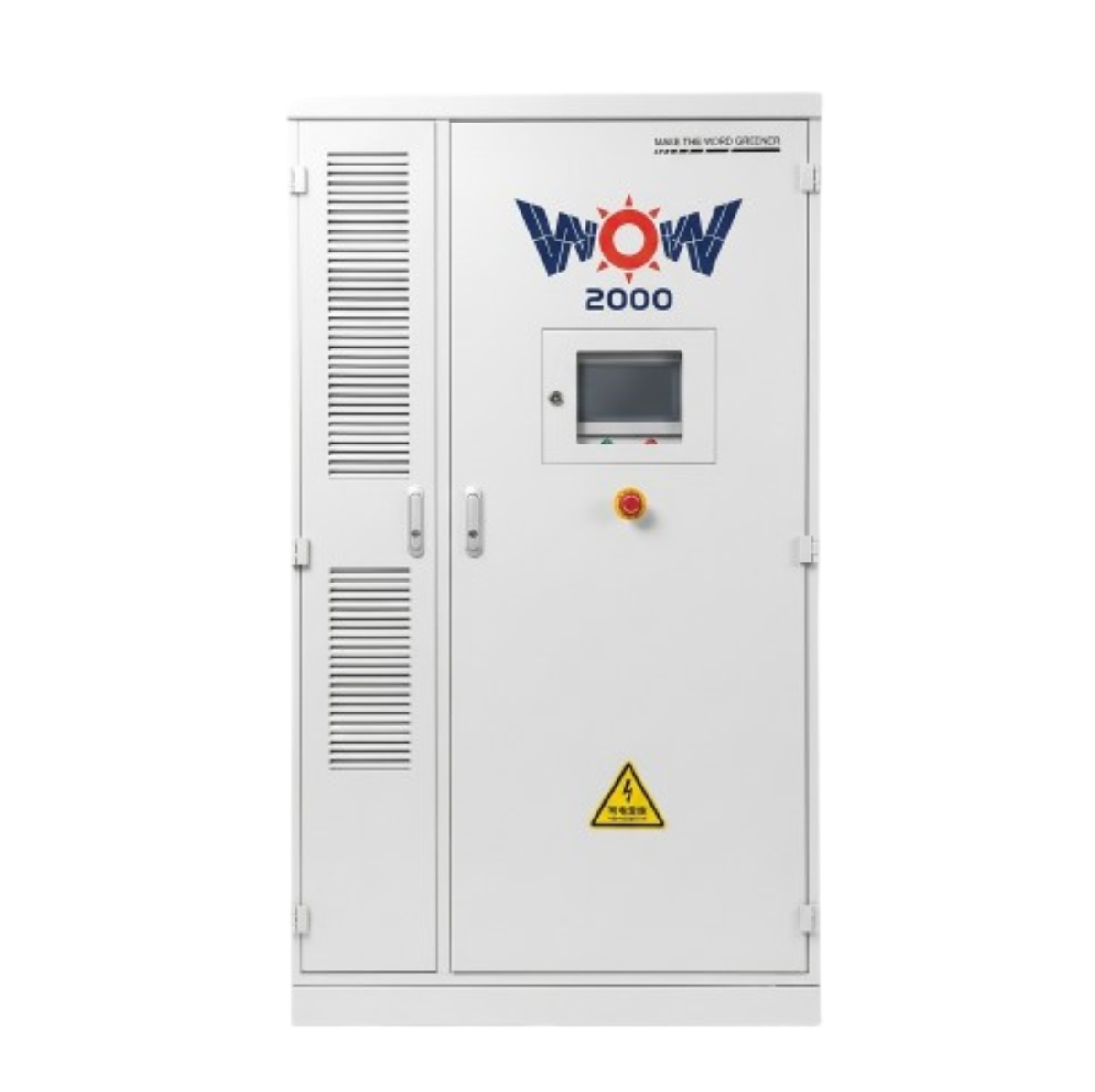
C&I Energy Storage System – 232.96 kWh
C&I ENERGY STORAGE SYSTEM
Integrated Architecture
Coordinates LFP battery assemblies,
a bidirectional converter, thermal management,
and fire protection in one system architecture.
Cabinet Configuration
Organizes the subsystems for integration on an approved project site.
Auxiliary AC/DC Supply
Supplies the control, monitoring, and auxiliary functions included in the selected configuration.
Integrated EMS
Supports charge and discharge strategies defined for the project objectives.
Architecture and Selection
Get a Quote
232.96 kWh / 100 kVA Reference Configuration
C&I Reference Configuration
This page describes a reference configuration for a commercial and industrial (C&I) energy storage system. It is not one standard model or a cabinet that can be connected without an engineering review. Capacity, bidirectional converter rating, protection, cooling, fire protection, electrical connection, and site work are adapted to the project and confirmed in the quotation and execution documents.
Calculation basis for this page: 280 Ah, 3.2 V LFP cells, five 1P52S battery assemblies, 232.96 kWh total nominal energy, and 100 kVA nominal AC apparent power. Last updated: August 19, 2026.
Configuration Calculations
- One 1P52S assembly: 52 cells in series × 3.2 V = 166.4 V nominal.
- Energy per assembly: 280 Ah × 3.2 V × 52 = 46.592 kWh nominal.
- Complete system: five 52-cell assemblies form a 1P260S system.
- Nominal voltage: 260 × 3.2 V = 832 VDC.
- Nominal energy: 5 × 46.592 kWh = 232.96 kWh.
- Displayed DC range: 754 to 923 V, equivalent to approximately 2.90 to 3.55 V per cell across 260 cells.
This page uses only a 280 Ah cell capacity for the 46.592 kWh, 232.96 kWh, and 832 VDC values. Actual usable energy is lower than nominal energy and depends on depth of discharge, BMS limits, efficiency, temperature, operating reserve, and ageing.
Reference Specifications
| Field | Reference Value |
|---|---|
| Page Role | Configurable C&I system, not a fixed SKU |
| Battery Chemistry | LFP (lithium iron phosphate) |
| Calculation Cell | 280 Ah / 3.2 V |
| Battery Assembly | 1P52S, 166.4 V nominal |
| Nominal Energy per Assembly | 46.592 kWh |
| Number of Assemblies | 5 |
| System Configuration | 1P260S |
| Nominal System Voltage | 832 VDC |
| Displayed DC Range | 754 to 923 VDC |
| Nominal System Energy | 232.96 kWh |
| Stated Charge/Discharge Rate | 0.5 C, subject to confirmation against the operating profile |
| Nominal AC Apparent Power | 100 kVA |
| Stated Maximum AC Apparent Power | 110 kVA |
| Cooling | Liquid |
| Stated Fire-Suppression Agent | Perfluorohexanone; final design depends on the site and applicable regulations |
| Estimated Weight | Approximately 1,750 kg |
The 100 kVA and 110 kVA values express apparent power. They must not be presented as 100 kW or 110 kW without stating the power factor, active power, permitted duration, and conditions of the selected converter.
System Architecture
The configuration combines battery assemblies, the BMS, bidirectional converter, EMS, auxiliary AC/DC supply, liquid cooling, fire detection and suppression, isolation devices, and protection equipment. The final design defines interfaces, protocols, measurement points, operating priorities, alarms, interlocks, emergency stop, and the responsibility of each component.
The project must also define the operating mode: peak shaving, PV self-consumption, time-of-use optimization, priority-load backup, microgrid operation, or another strategy. A battery and PCS alone do not guarantee island operation, black start, or uninterrupted transfer; those functions depend on the complete architecture.
Site, Installation, and Safety
A system of approximately 1,750 kg and 832 VDC requires site approval before delivery: dimensions and access, handling, slab or foundation, indoor or outdoor environment, temperature, humidity, altitude, salt air, drainage, ventilation, clearances, earthing, cable routing, protection coordination, and maintenance access. It must not be described as ready to use on delivery before connection, settings, testing, and acceptance are complete.
Data Confirmed During Engineering Review
- usable energy, DoD, efficiency, reserve, cycles, end-of-life SOH, and applicable warranty;
- PCS model, active power in kW, power factor, efficiency, THD, and P/Q capability;
- BMS/EMS architecture, protocols, cybersecurity, remote access, and data ownership;
- dimensions, IP rating, environment, sound level, auxiliary consumption, and cooling maintenance;
- detection, suppression, isolation devices, insulation monitoring, overcurrent protection, and surge protection;
- grid/off-grid mode, transformer, switchboard, protection, site work, testing, training, and acceptance.
Estimated Budget in Gabon
5,000,000 to 12,000,000 XAF, depending on capacity, power, protection, integration scope, and site conditions. This estimate, dated August 19, 2026, does not represent two fixed offers and does not automatically include delivery, handling, foundations, installation, electrical work, the transformer, or unlisted options. The written quotation states the configuration, quantities, tax status, inclusions, exclusions, and validity period.
Prepare the Quote Request
Provide the location, load profile, peak demand, daily energy, operating objectives, required autonomy, site voltage, grid topology, existing PV generation or generator, installation constraints, and schedule. WOW2000 uses this data to confirm or adapt the reference configuration.
Request an engineering review and quotation for the C&I system or contact WOW2000.