wow2000.com


Gabon: Protecting Cold Storage Facilities and Cold Rooms with Solar Power
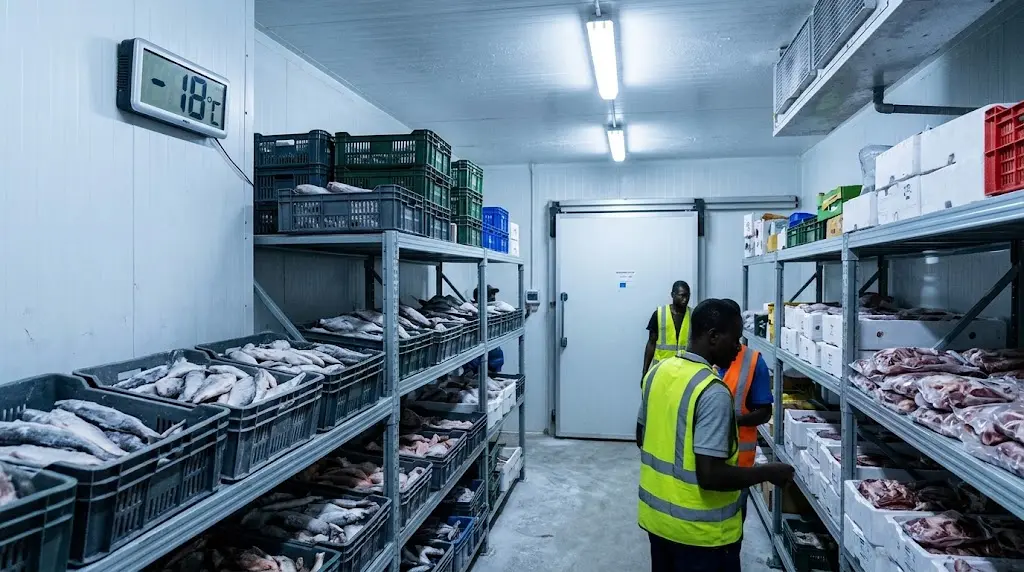
An industrial refrigeration compressor is not a kitchen refrigerator. Its power consumption, starting current, thermal cycles, and voltage tolerances are radically different from anything a residential solar system is designed to handle. A cold storage warehouse or cold room in Gabon presents the most demanding sizing challenge for a solar installer—because there is no room for error. A break in the cold chain lasting just a few hours in the tropical heat can destroy tons of goods and result in losses of several million CFA francs.
This article explains why the technical constraints of industrial refrigeration compressors differ so greatly from those of other electrical loads—and what this means in practical terms for sizing a solar protection system.
To learn more about the categories of solutions offered by WOW2000, visit Our Solutions.
Why Refrigeration Compressors Are the Most Difficult Load to Size
Actual power consumption vs. the plate's rated power
The most common sizing error for a cold room is to rely solely on the rated power indicated on the compressor’s nameplate. This value—expressed in kilowatts or horsepower—corresponds to the mechanical power delivered by the motor under reference conditions. It does not represent the actual electrical power consumed under operating conditions in Gabon.
The actual electrical power consumed by a refrigeration compressor depends on several operational parameters—the temperature of the cold room to be maintained, the outdoor ambient temperature, the compressor’s load factor, and the condition of the seals and thermal insulation of the enclosure. In the tropical heat of Gabon, a compressor operates more intensively than in temperate conditions—its actual power consumption can exceed the value listed on the nameplate by 20 to 40%.
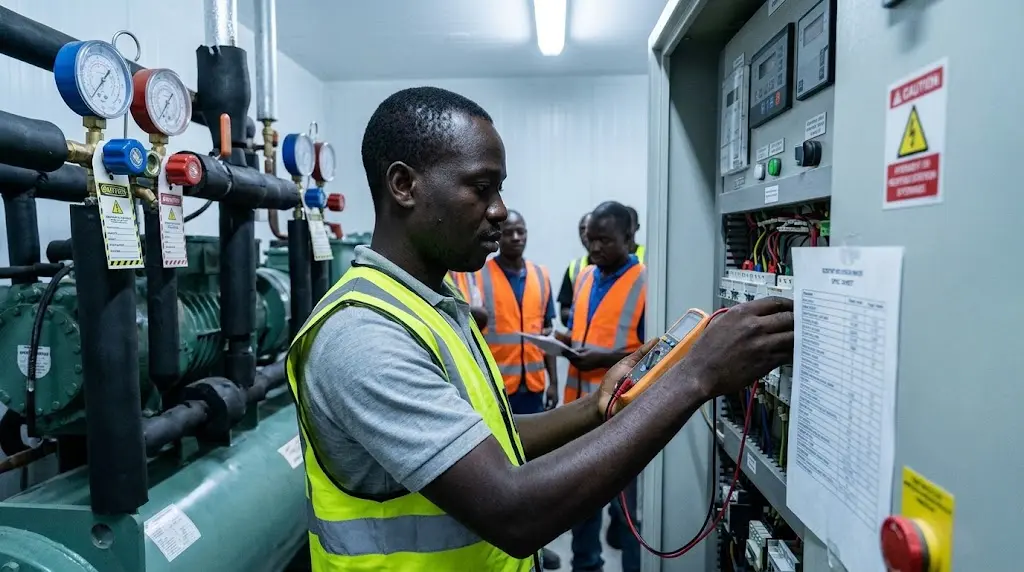
To properly size a solar system for a cold storage room in Gabon, the actual power consumption must be measured on the existing compressor using a current clamp—not estimated based on the nameplate. This measurement must be taken during a period of steady-state operation—not at startup.
Inrush current—the most critical parameter for the inverter
The starting current of a refrigeration compressor with an asynchronous motor—the most common type in Gabonese cold storage facilities—can reach 5 to 7 times the rated current during the first 2 to 5 seconds of startup. For a compressor with a rated power of 5 kW, the starting current can thus reach 25 to 35 kW of instantaneous power.
The solar inverter must be able to handle this startup surge without triggering its protective mechanisms. The inverter’s peak power—which is distinct from its rated power—is the parameter that determines this capability. A 10-kW rated inverter may have a peak power of 20 kW or 30 kW depending on the model—a considerable difference when sizing the protection for an industrial refrigeration compressor.
This specification—the inverter’s peak power—must be explicitly stated and compared to the compressor’s measured starting current before making any purchase.
Operating cycles—what determines actual energy consumption
How Much Power Does a Refrigeration Compressor Actually Consume?
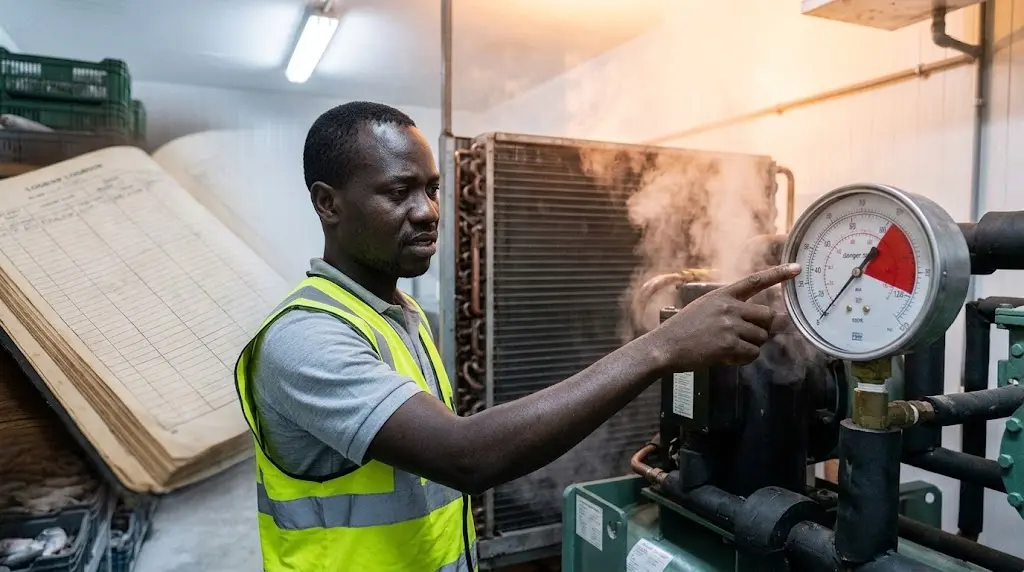
A refrigeration compressor does not run continuously. It alternates between on and off cycles depending on the temperature in the cold room. When the temperature rises above the set point, the compressor starts up and cools the room. When the temperature drops back to the set point, the compressor shuts off.
The ratio of runtime to the total duration of a cycle is called the duty cycle or operating ratio. For a well-insulated cold room in Libreville maintained at -18°C, the duty cycle can range from 40 to 70% depending on the outside ambient temperature, the quality of the room’s insulation, and the frequency of door openings.
This parameter is essential for calculating actual electricity consumption over a 24-hour period. A 5-kW compressor with a duty cycle of 60% actually consumes 5 × 0.60 × 24 = 72 kWh per day—not 120 kWh, as continuous operation at full power would suggest. This distinction is fundamental to properly sizing the battery.
The Impact of Tropical Heat on Walking Speed
In Libreville, the outdoor ambient temperature can reach 35 to 38°C during the day. This heat significantly increases the duty cycle of refrigeration compressors compared to a temperate climate. A compressor designed for a duty cycle of 40% in Europe may operate at a duty cycle of 65 or 70% in Libreville.
This parameter must be measured on site—not estimated based on the manufacturer’s technical data sheets, which were prepared for a different climate. Measuring the actual 24-hour operating rate during the peak summer season provides the most reliable baseline data for sizing the backup battery system.
Power Quality Requirements for Refrigeration Compressors
Voltage tolerance—an often-overlooked requirement
The motors in industrial refrigeration compressors are far more sensitive to voltage fluctuations than those in standard household appliances. A three-phase induction motor—commonly found in medium-sized cold storage warehouses in Gabon—generally tolerates a voltage variation of ±10% relative to its rated voltage. Beyond these limits, the motor overheats, its efficiency decreases, and its service life is shortened.
In Port-Gentil and the industrial zones of Owendo, voltage fluctuations in the SEEG grid can exceed these limits—particularly during changes in grid load or when power is restored after an outage. A hybrid inverter that regulates the output voltage independently of the grid voltage protects the compressor motor from these fluctuations.
Phase imbalance in three-phase systems
Large-capacity cold storage facilities typically use three-phase compressors—powered by three 220V phases rather than a single phase. A voltage imbalance between the three phases—even a slight one—causes an increase in current in the most heavily loaded phase and abnormal motor overheating.
A three-phase inverter designed to power an industrial compressor must ensure that the phase imbalance is less than 2%, in accordance with applicable standards. This parameter must be verified in the inverter’s technical data sheet and measured during commissioning.
Compatibility with variable-frequency drives
Some modern refrigeration compressors are equipped with variable-frequency drives—electronic devices that allow the compressor speed to be adjusted according to the thermal load. These drives have specific power quality requirements—notably low harmonic distortion in the current supplied by the inverter. A standard inverter can generate harmonics that interfere with the operation of a variable-frequency drive. Compatibility between the solar inverter and existing variable-frequency drives must be verified before installation.
Technical information to gather before requesting a study
When planning a cold storage facility or cold room in Gabon, a thorough assessment relies on actual measurements—not estimates. Here is the essential information you need to gather before contacting an installer.
Measurements to Be Taken On-Site Before the Estimate
These measurements cannot be replaced by technical data sheets. They must be performed on the existing system under its actual operating conditions.
| Action to be taken | Measurement Method | Its impact on sizing |
|---|---|---|
| Actual power consumption of the compressor at steady state (kW) | Clamp-on ammeter on the power cables during operation | Determine the required rated power of the inverter. |
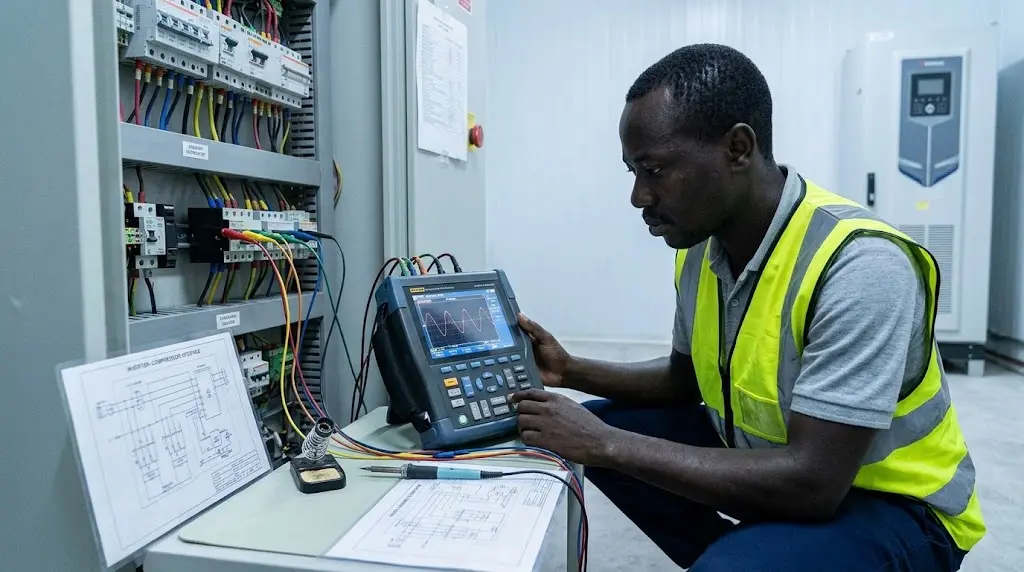
| Compressor starting current (A) | Oscilloscope or peak-holding current clamp | Determines the required peak power of the inverter. |
| Compressor operating rate over 24 hours (%) | Data logger or manual observation over a 24-hour period | Calculates the actual daily consumption in kWh. |
| Supply Voltage and Phase Imbalance (V) | Network Analyzer on the Electrical Panel | Check for compatibility with the inverter you are considering. |
| Ambient temperature in the engine room (°C) | Probe Thermometer | Affects the duty cycle and service life of the compressor. |
| Presence of variable-frequency drives | Visual inspection and technical documentation | Determines the inverter's power quality requirements. |
Technical Documents to Be Submitted
In addition to the measurements, these documents help round out the technical analysis prior to the estimate.
- The compressor's nameplate — rated power, voltage, rated current, power factor.
- The electrical diagram of the refrigeration panel — if available.
- SEEG bills from the past 6 months — to identify actual consumption and seasonal variations.
- Photos of the utility room — compressor, electrical panel, space for the inverter and battery.
- The Enclosure's Surface Area and Insulation — thickness and type of wall insulation, condition of door seals.
According to data from BloombergNEF on the Energy Storage Market, the costs of industrial storage systems have fallen significantly in recent years—making solar shading for refrigeration facilities economically viable for medium-sized warehouses in Gabon.
System Architectures Suitable for Cold Storage Facilities in Gabon
A Pure Fallback Architecture—Protecting the Network Without Replacing It
In this configuration, the solar system only activates during SEEG grid outages. During normal operating hours, the compressor is powered by the grid. During an outage, the hybrid inverter switches to battery power and keeps the compressor running.
This architecture is the simplest to implement and the least expensive. It does not reduce the SEEG bill but does protect the cold chain. It is suitable for warehouses whose primary concern is maintaining the cold chain during power outages—not reducing energy costs.
The Self-Consumption with Backup Architecture — Reduce Your Bill and Protect the Cold Chain
In this setup, the solar panels power the compressor during daylight hours—reducing consumption from the SEEG grid. The battery stores the excess energy to provide backup during nighttime outages.
This architecture is more complex to size—it requires balancing solar generation, compressor consumption, and the battery capacity needed for nighttime protection. It is suitable for warehouses that want to both reduce their electricity costs and maintain the cold chain.
Remote Monitoring—Essential for a Cold Storage Warehouse
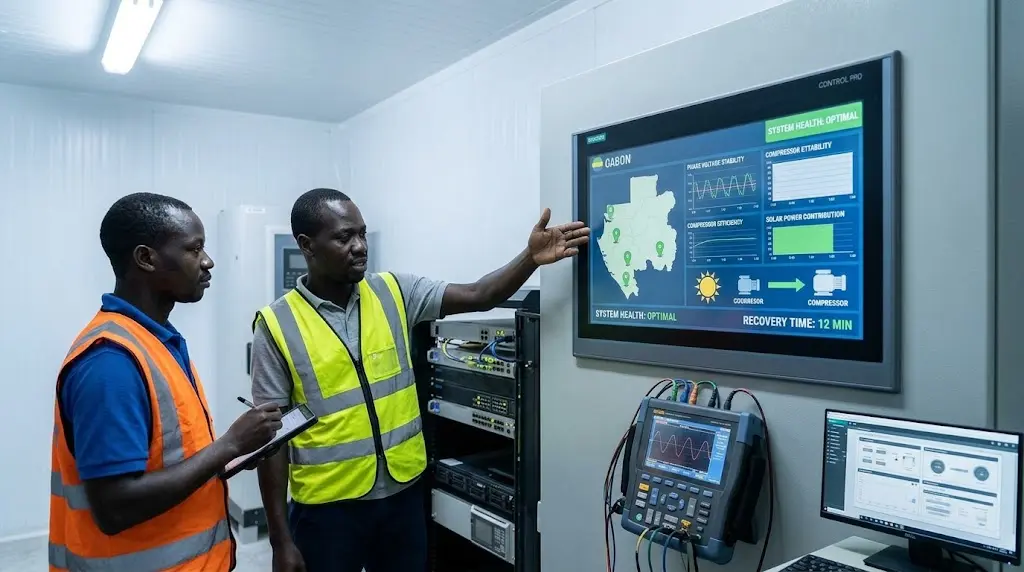
Regardless of the architecture chosen, a remote monitoring system for the chamber temperature and the status of the solar system is essential for a cold storage facility. It allows for the detection of any anomalies—such as a rise in the chamber temperature or an inverter alarm—before the cold chain is compromised. To learn more about the criteria for selecting an installer capable of managing this type of system remotely, see our article on How to Choose a Solar Energy Company in Libreville.
Next step: Prepare your request for a technical study
For a cold storage facility or cold room in Gabon, the technical study must begin with the steps outlined in the table above—not with a generic request for a quote. These steps make it possible to precisely determine the inverter’s power rating, the battery capacity, and the system architecture best suited to your facility.
Gather the measurements and documents listed above and contact WOW2000 to begin a technical discussion. To understand the steps that follow this initial contact, see our article on The Stages of a Solar Project, from Design to Commissioning.
You can contact the team via WhatsApp or via the page Contact Us.
Publisher Disclosure: This article is published by WOW2000 for general informational purposes. The technical specifications presented—starting currents, duty cycles, voltage tolerances—are indicative orders of magnitude. The actual values for a specific installation in Gabon depend on the compressor model, operating conditions, and the condition of the installation. Only on-site measurements can provide an accurate and reliable sizing.
Frequently Asked Questions — Sun Protection for Cold Storage Facilities in Gabon
Why can't a standard residential UPS be used to protect a cold storage facility?
A residential inverter is rated for light loads—lighting, televisions, chargers. An industrial refrigeration compressor has a starting current that can be as much as 5 to 7 times its rated current—a value that most residential inverters cannot handle without triggering their protective circuits. The inverter must be selected based on the compressor’s measured starting current—not on the system’s rated power.
How do you measure the starting current of an existing refrigeration compressor?
The starting current is measured using a peak-holding current clamp placed on the compressor’s power cables. The operator manually initiates a compressor start—after a sufficient shutdown period to allow the refrigerant circuit pressure to equalize—and the clamp records the peak value reached during the first few seconds. This measurement must be performed by a qualified electrical technician.
Can a three-phase cold storage facility be powered by a solar inverter?
Yes, provided that the inverter is three-phase and its phase imbalance is within the tolerances of the compressor motor—generally less than 2%. Industrial three-phase inverters suitable for this type of application differ from standard residential single-phase inverters. This should be verified in the technical data sheet for the inverter under consideration.
How long does a cold storage room maintain its temperature during a power outage without a backup system?
This depends primarily on the quality of the cold room’s thermal insulation, the target temperature, and the outdoor ambient temperature. A well-insulated cold room set to -18°C can maintain its temperature for 2 to 4 hours, depending on these factors. In the tropical heat of Libreville, this duration is often shorter. This factor must be evaluated for each specific installation.
Is remote temperature monitoring required for a cold storage facility equipped with solar panels?
It is not mandatory under regulations—but it is essential from an operational standpoint. Without remote monitoring, a malfunction in the solar system or a rise in the chamber’s temperature could go unnoticed for several hours—posing a risk of product loss. A monitoring system triggers an alert as soon as the temperature exceeds a defined threshold, allowing for intervention before the cold chain is compromised.