wow2000.com


Libreville: Solar Solutions for Convenience Stores and 24-Hour Grocery Stores
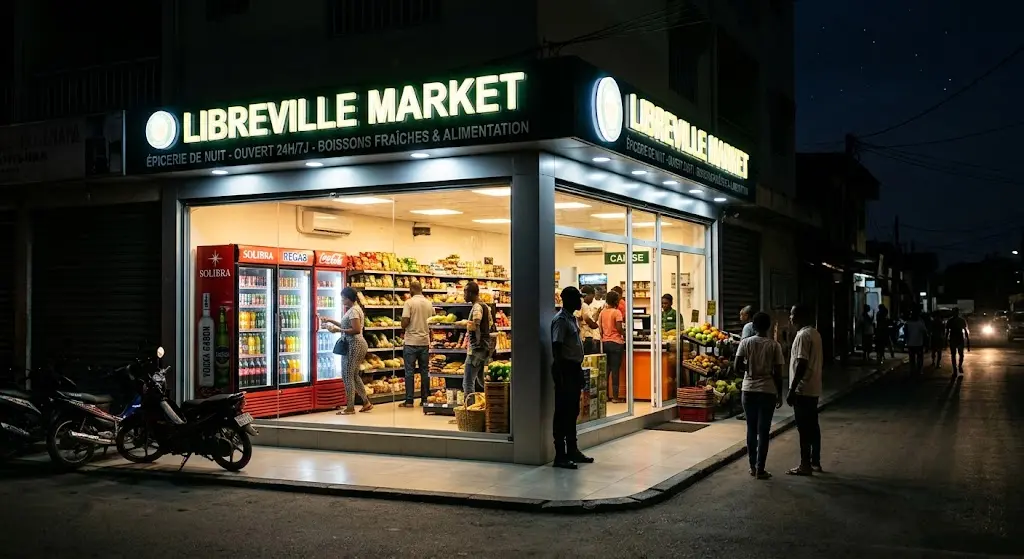
A late-night grocery store in Libreville isn’t your typical convenience store that closes at 6 p.m. It opens when others close—and generates most of its revenue between 8 p.m. and 2 a.m. This nighttime operating schedule radically changes the solar energy equation. A system designed to power a daytime business—which generates electricity during daylight hours and consumes it simultaneously—does not meet the needs of a business whose entire operation takes place when the solar panels are no longer generating power. This article explains why the nighttime operating pattern of a 24-hour grocery store requires a specific system design—and what data to gather before requesting a feasibility study.
To learn more about the categories of solutions offered by WOW2000, visit Our Solutions.
Why a 24-hour grocery store’s nighttime profile changes everything when it comes to sizing
The fundamental difference between a daytime store and a late-night grocery store
A business that operates during the day uses electricity while the sun is shining. The solar panels generate power and supply it directly to the appliances—the battery stores any surplus. This is the principle of solar self-consumption at its most efficient.
A 24-hour grocery store operates in the opposite way. It uses little or no electricity during peak solar production hours. All electricity consumption—store lighting, beverage refrigeration, the cash register, and ventilation—is concentrated during a 6- to 8-hour period at night. The solar system must therefore store enough energy during the day to fully power the store throughout the night—without any input from the panels during business hours.
This requirement necessitates a battery capacity significantly greater than that of an equivalent daytime business. For the same total daily energy consumption, a late-night grocery store needs a battery two to three times larger than that of a store operating during the day—because all the energy must be stored before it is consumed, with no possibility of simultaneous generation.
What the nighttime shutdown means for a 24-hour grocery store
For a convenience store or late-night grocery store in Libreville, a power outage from the SEEG grid isn’t just an inconvenience—it means an immediate shutdown during the most profitable time of the day. The hours between 8 p.m. and midnight are when foot traffic is at its peak—workers returning home late, families in need of a basic necessity, and customers looking for cold drinks after a hot day.
The direct economic impact of a nighttime power outage on a 24-hour grocery store includes lost sales during the outage, loss of beverages and refrigerated products if the outage is prolonged, and the loss of customers who go to a competing store that is equipped with a backup power system. In Libreville, where nighttime power outages are frequent in many neighborhoods, a 24-hour grocery store without a backup power system experiences these losses on a regular and predictable basis.
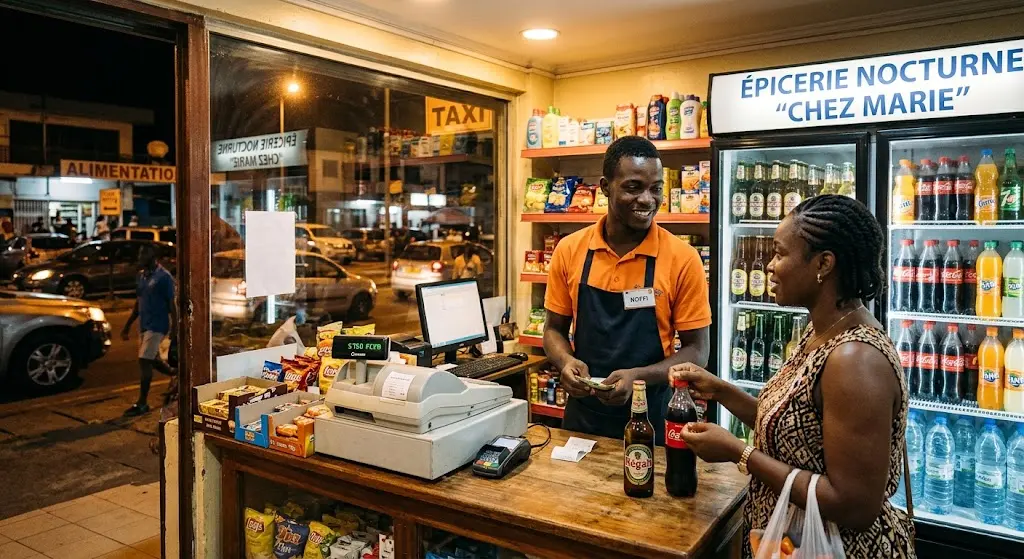
The Specific Expenses of a 24-Hour Grocery Store in Libreville
Commercial nighttime lighting—the first load to be sized
Lighting is both the most visible expense and one of the most important factors in attracting customers at night. A well-lit grocery store on a street plunged into darkness during a SEEG power outage attracts customers from nearby stores that are closed. This nighttime competitive advantage is one of the most measurable benefits of a solar system for a 24-hour grocery store in Libreville.
The total power consumption of the lighting depends on the store’s floor area and the type of light bulbs used. LED bulbs consume between 8 and 15 watts each, depending on their light output. A lighting system consisting of 20 12-watt LED bulbs represents a continuous load of 240 watts—or 1,440 Wh for a 6-hour night. This calculation forms the basis for sizing the lighting system in the battery.
Beverage Refrigeration—The Night Grocery Store’s Critical Task
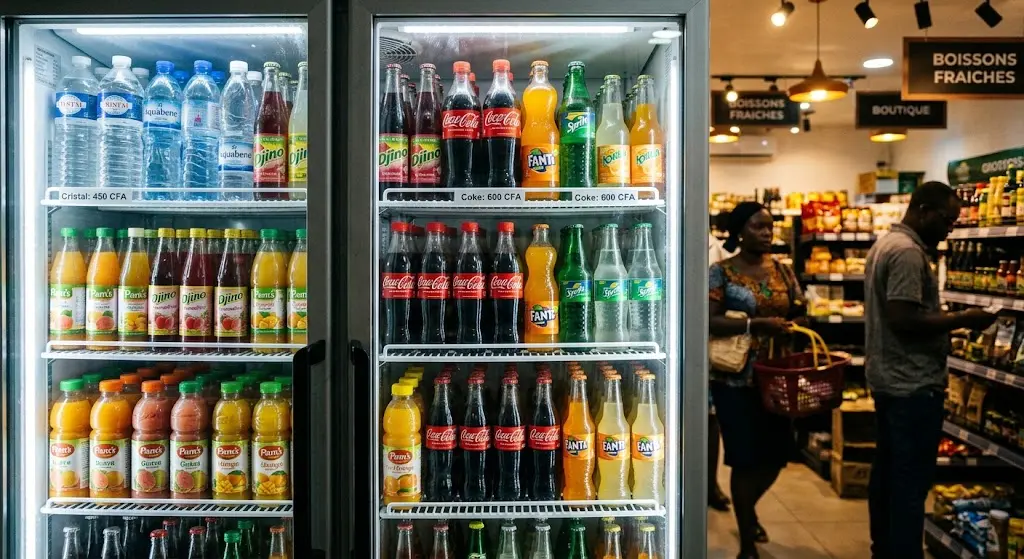
Refrigeration is the most critical operation at a 24-hour grocery store in Libreville. Chilled beverages—water, sodas, juices, and beer—are often the best-selling items at night. A beverage refrigerator that is turned off for several hours in the tropical heat can quickly heat up—causing the products to lose their freshness and diminishing the store’s commercial appeal.
The energy consumption of a commercial beverage refrigerator varies depending on its capacity and energy efficiency. A 300-liter refrigerator typically consumes between 1.5 and 2.5 kWh per day when operating continuously in the heat of Gabon. For many refrigerators—common in well-stocked grocery stores—total energy consumption can reach 4 to 6 kWh per night, which is the most significant factor in battery sizing.
Cash, the Internet, and Security—Critical Operational Burdens
The cash register, mobile payment terminal, and Wi-Fi router are low-power devices—typically between 50 and 150 watts in total—but they are critical to business operations. A cash register outage during a busy period disrupts service and can result in lost sales.
Video surveillance is particularly important for a 24-hour grocery store—nighttime hours make this type of business more vulnerable to theft. A surveillance camera consumes between 5 and 15 watts. A 4-camera system with a recorder draws approximately 60 to 80 watts continuously—or 360 to 480 Wh for a 6-hour night shift.
Ventilation—an essential factor for comfort in tropical regions
Ventilation in commercial spaces is essential at night in Libreville’s tropical climate to ensure the comfort of employees and customers. A ceiling fan consumes between 40 and 80 watts. A portable air conditioner consumes between 800 and 1,500 watts.
The decision of whether or not to include air conditioning in the scope of the nighttime backup power system has a particularly significant impact on a 24-hour grocery store—it can double or triple the required battery capacity. A ceiling fan is an alternative that maintains an acceptable level of comfort while consuming significantly less power.
How to Calculate the Battery Capacity Needed for a Full Night
The calculation method specific to the nighttime profile
For a 24-hour grocery store in Libreville, the required battery capacity is calculated based on total nighttime consumption—not daily consumption. Here is the basic calculation method.
Step 1 — Make a list of all nighttime electrical loads and their power consumption in watts
For each appliance that will be running during nighttime hours, note its rated power in watts—as indicated on the label. Distinguish between appliances that run continuously—refrigerators, lighting, video surveillance—and those that run intermittently—cash registers, fans, chargers.
Step 2 — Calculate total nighttime energy consumption in Wh
For each appliance: power (W) × nighttime operating time (hours) = energy consumption (Wh). The sum of all these energy consumption values gives the total nighttime energy consumption in Wh.
Step 3 — Calculate the minimum battery capacity
For a LiFePO4 lithium battery with a depth of discharge of 80%: minimum capacity (kWh) = total nighttime consumption (Wh) ÷ 0.80 ÷ 1,000.
For a lead-acid battery with a depth of discharge of 50%: minimum capacity (kWh) = total nighttime consumption (Wh) ÷ 0.50 ÷ 1,000.
Step 4 — Calculate the power output of the solar panels needed to charge the battery in one day
Panel power (kWp) = battery capacity (kWh) ÷ effective sunshine hours in Libreville (4.5 hours) ÷ system efficiency (0.75).
This calculation is a preliminary estimate—the precise sizing takes into account additional parameters that can only be evaluated after a technical site visit.
Information to Gather Before Requesting a Study
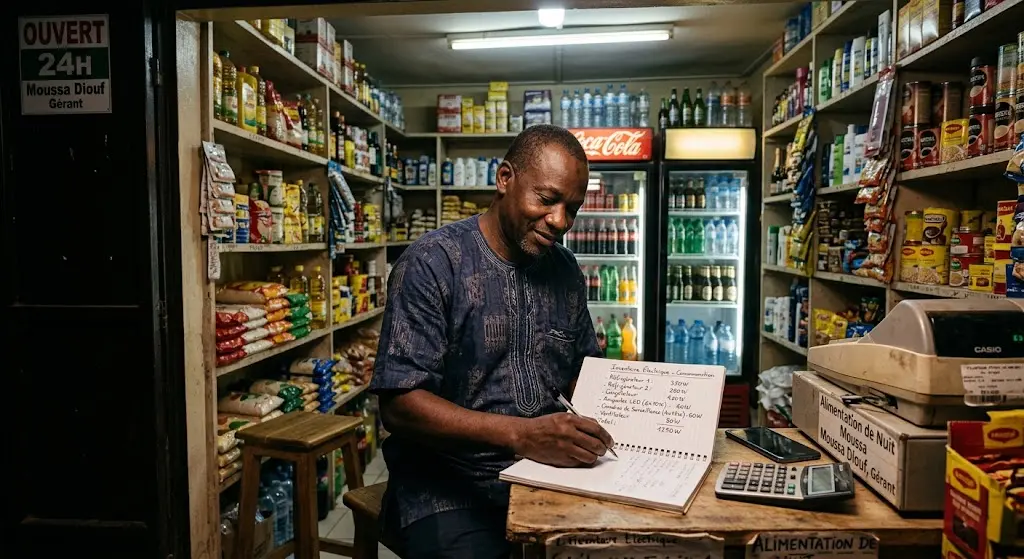
Before contacting an installer, gathering this information will help ensure that the system is accurately sized to meet the specific nighttime energy profile of your grocery store in Libreville.
What Your 24-Hour Grocery Store Needs to Document
The accuracy of this information directly determines the quality of the proposed design. A facility manager who provides an accurate inventory of their nighttime loads will receive a much more reliable proposal than one based on a rough estimate.
| Information to Be Provided | Its Impact on Nighttime Capacity Sizing |
|---|---|
| List of nighttime appliances by power (W) | Basis for calculating total nighttime consumption—the key parameter for sizing. |
| Number and Capacity of Beverage Refrigerators | Refrigeration is often the dominant component—its total power determines the battery capacity. |
| Evening Hours | Determining the duration of nighttime consumption—from 8 p.m. to 2 a.m. or from 6 p.m. to 4 a.m.—significantly changes the calculation. |
| Lighting — Number and Wattage of Light Bulbs | Calculate the total lighting power in watts and multiply it by the number of hours at night to get the lighting energy consumption. |
| Video Surveillance — Number of Cameras and Recorder | Low power consumption but continuous operation — to be included in the nighttime calculation. |
| Air Conditioning or Fans | A key decision that can double the required battery capacity if air conditioning is included. |
| Typical duration of power outages in your neighborhood | Although power outages generally last 4 hours, the battery must be able to provide power for at least 4 hours. |
| Available roof space | Determines the maximum power of the panels that can be installed to charge the battery during the day. |
The Key Issue Regarding the Cold Chain
If your 24-hour grocery store sells refrigerated products that spoil quickly—such as dairy products, meat, and medications—the cold chain is an absolute necessity that must not be overlooked when sizing the system. A solar system that powers the lighting but not the refrigeration does not meet the primary need of this type of business.
The maximum acceptable temperature in beverage refrigerators during a power outage depends on the products being stored. This temperature constraint must be specified during the design phase so that the technician can incorporate the necessary safety margin into the battery capacity calculation.
According to data from Our World in Data on Renewable Energy, the cost of battery storage has continued to fall in recent years—making nighttime backup systems affordable for small businesses such as neighborhood grocery stores in Libreville.
Red Flags in the Proposals Received for a 24-Hour Grocery Store
A system sized for a residential home
A system designed for a residential household—which uses electricity in the evening and at night—may seem suitable for a 24-hour grocery store. The difference is that a residential household uses electricity gradually and at a lower rate at night, while a grocery store uses it intensively and continuously. A residential system may prove insufficient as early as the first night of intense commercial activity.
Battery capacity calculated based on daytime usage
An installer who calculates the battery capacity based on total daily consumption—including a portion of daytime consumption that does not exist for a 24-hour grocery store—will recommend an undersized battery. The calculation should be based solely on actual nighttime consumption.
A proposal that makes no mention of the startup peaks of refrigerators
Commercial refrigerators have a compressor startup current that can reach 3 to 5 times their rated power. For a 24-hour grocery store with multiple refrigerators that restart simultaneously after a power outage, the UPS must be sized to handle these simultaneous peaks. A proposal that does not specify the inverter’s peak power capacity in relation to the refrigerators’ startup peaks is incomplete.
Next step: Prepare your feasibility study proposal for your 24-hour grocery store in Libreville
To begin a study tailored to your 24-hour grocery store in Libreville, compile a list of your nighttime energy-consuming equipment—refrigerators, lighting, cash register, video surveillance—along with their rated power, your hours of operation, and the typical duration of power outages in your neighborhood. This information will enable us to engage in a detailed technical discussion.
To help you further consider the specific needs of your business, check out our article on The solar energy company for your installations in Port-Gentil, managed from Libreville which addresses the unique characteristics of Gabonese businesses.
You can contact the team via WhatsApp or via the page Contact Us.
Publisher Disclosure: This article is published by WOW2000 for general informational purposes. The energy consumption figures presented are indicative estimates based on typical devices—actual values vary depending on the model and conditions of use. Accurate sizing of a system for a 24-hour grocery store in Libreville requires an on-site technical assessment based on the store’s actual data.
Frequently Asked Questions — Solar Solutions for Convenience Stores in Libreville
Why does a 24-hour grocery store need a larger battery than a daytime store of the same size?
Because all of a 24-hour grocery store’s energy consumption occurs at night—when the solar panels are no longer generating any power. The battery must store all the energy needed during the day to power the entire store for 6 to 8 hours at night without any solar input. A store that operates during the day, on the other hand, uses part of the solar panels’ output directly—thereby reducing the required battery capacity.
How long do drinks stay cold if the refrigerator stops working during a power outage?
A closed commercial refrigerator maintains its internal temperature for 2 to 4 hours, depending on its insulation and the ambient temperature. In the tropical heat of Libreville, this duration is typically 1 to 2 hours before the temperature begins to rise significantly. For a 24-hour grocery store, where power outages can last several hours, continuous refrigeration is therefore essential, and the solar system must fully cover this need.
Can a solar power system power all the appliances in the 24-hour grocery store at the same time?
Yes, provided that the system is properly sized for the total power of the appliances and their startup peaks. An inverter with insufficient peak power may trip when several refrigerators start up simultaneously. Accurately sizing the UPS power based on the grocery store’s actual loads is an essential step in the technical analysis.
Can the video surveillance system operate continuously throughout the night using the solar power system?
Yes. Video surveillance cameras and recorders have low power consumption—generally between 5 and 15 watts per camera. A 4-camera system with a recorder consumes about 60 to 80 watts continuously. This load represents about 360 to 480 Wh for a 6-hour night—a relatively modest amount to factor into the overall battery calculation.
Does a 24-hour grocery store need a large roof area to install enough solar panels?
It depends on the grocery store’s total nighttime energy consumption. For nighttime consumption of 10 kWh—refrigeration, lighting, checkout, ventilation—about 3 kWp of solar panels are needed to fully charge the battery in one day in Libreville. Three 400 Wp panels cover approximately 5 m² of roof space. This amount of space is generally available on the roofs of most neighborhood grocery stores.