wow2000.com


How much does a residential solar kit with backup power cost in Gabon?
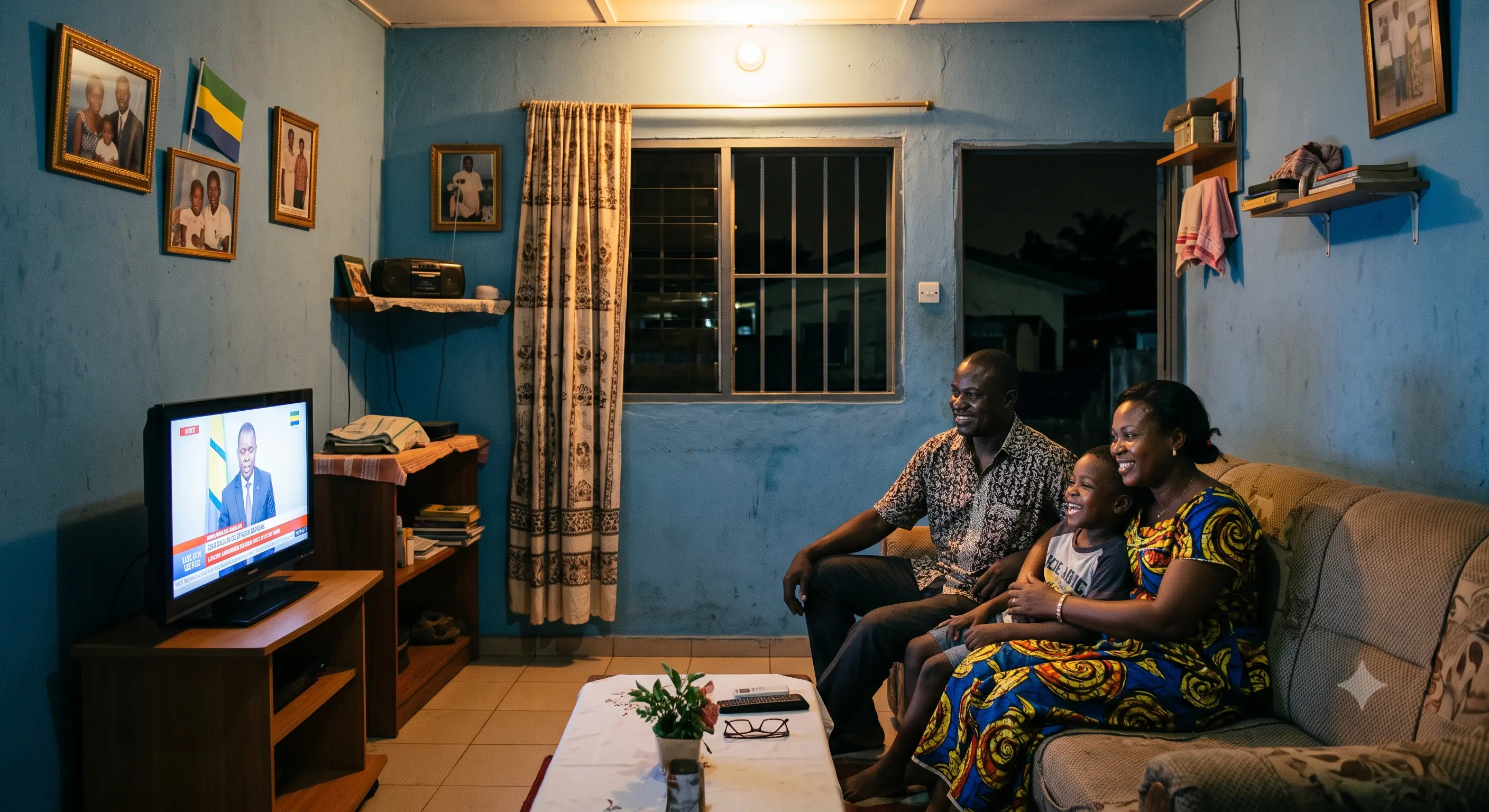
The cost of a residential off-grid solar kit in Gabon isn’t based on a fixed price—it’s calculated based on three variables that depend on you: the devices you want to protect, the number of hours of backup power you need, and the kit level you choose. This article provides a practical framework for understanding how these three variables determine the cost of your backup power system.
To learn more about the categories of solutions offered by WOW2000, visit Our Solutions.
Variable 1 — Your Key Expenses: What You Really Want to Protect
The first factor that determines the cost of your power-outage kit is the specific list of devices you want to keep running during a power outage. This list is called your key expenses.
How to Identify Your Key Expenses
Think about a typical power outage in your home. Which appliances, if they stopped working, would cause you a real problem—not just inconvenience? The refrigerator, which might defrost? The air conditioner in the master bedroom, which you need to sleep at night? The Wi-Fi, which the kids need to do their homework?
For each appliance you identify, note its rated power in watts—as indicated on the label attached to the appliance. This power rating is the technical figure that determines the required inverter power.
The Impact of Air Conditioning on Costs
Air conditioning is the only appliance on this list that warrants special attention. A standard 1.5 CV air conditioner consumes between 1,000 and 1,500 watts during operation—with a startup peak of up to 3,000 to 4,500 watts. Including even a single air conditioner in your key loads significantly changes the required inverter power rating. Including two or three radically changes the kit’s configuration—and its cost.
The question isn't whether air conditioning is useful—it is—but whether you really need it during nighttime power outages, or if a ceiling fan might be enough. This simple choice has a greater impact on the total cost than any other factor.

Variable 2 — Your desired battery life: how many hours without a network connection
The second variable is how long you want your system to operate without sunlight or the SEEG grid. This variable directly determines your battery capacity—and is therefore one of the most significant budget items.
Keep track of your power outages to estimate your battery life
The required battery life depends on the typical duration of power outages in your neighborhood. A two-hour outage and a twelve-hour outage require different battery capacities. If you don’t know exactly how long power outages typically last in your neighborhood in Libreville, Owendo, or Akanda, keep a log for a few weeks—including the date, start time, and duration. This data will help you accurately determine the battery capacity you need.
The Direct Relationship Between Range and Battery Cost
The relationship between desired runtime and battery cost is approximately linear. Doubling the desired runtime roughly doubles the required battery capacity—and thus its cost. Increasing runtime from 4 hours to 8 hours represents a significant additional investment. This decision should be made with full knowledge of the facts, taking into account the actual duration of power outages in your environment.
Battery technology — an impact on long-term costs
The choice of battery technology affects both the initial cost and the total cost over the system’s lifetime. Lead-acid batteries have a lower initial purchase cost but a shorter lifespan under Gabon’s tropical conditions. Lithium batteries represent a higher initial investment but have a significantly longer cycle life. Over the total lifetime of use, the cost per kilowatt-hour stored is often more competitive with lithium technology. To learn more about this topic, see our article on the’Residential solar power with a lithium battery in Gabon.

Variable 3 — Your kit level: three comparable configurations
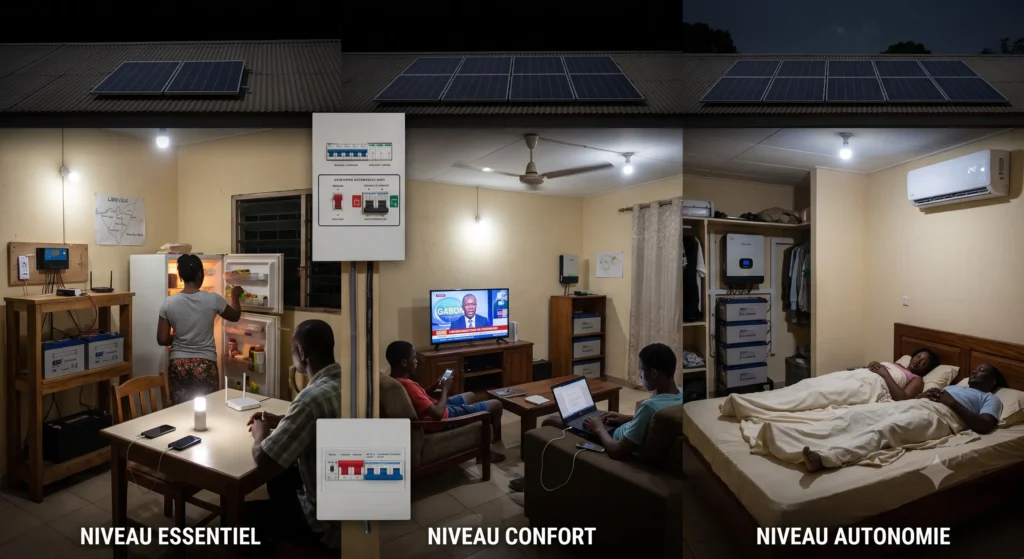
The third variable is the kit level you choose. In practice, power-outage kit configurations fall into three levels—each corresponding to a set of key loads and a typical runtime.
Essential Level — Protecting What Matters Most
This level covers only critical loads: refrigerator, LED lighting, Wi-Fi, and phone chargers. It is suitable for households that want to protect their food supplies and maintain minimal connectivity during short- to medium-length power outages—without air conditioning in the home.
What this level requires: a moderate-power inverter, a medium-capacity battery rated for 4 to 6 hours of runtime, and 2 to 4 solar panels to recharge the battery in one day.
This level is appropriate if: Power outages in your neighborhood rarely last more than 4 to 6 hours, and if you can sleep without air conditioning during a nighttime outage.
Quality of Life — Maintaining Your Usual Lifestyle
This level adds major loads to the critical loads of the essential level: fans, televisions, and computers. It is suitable for households that wish to maintain an acceptable level of comfort during power outages lasting 6 to 8 hours—still without air conditioning in the area.
What this level requires: an intermediate-power inverter, a larger-capacity battery rated for 6 to 8 hours of runtime, and 4 to 6 solar panels.
This level is appropriate if: You experience regular power outages lasting several hours and want your daily life at home to continue as usual—without having to go without the essentials.
Range — include air conditioning
This tier includes air conditioning in addition to the costs covered by the two previous tiers. It is suitable for households that experience frequent, prolonged power outages at night and wish to maintain full thermal comfort while sleeping.
What this level requires: a high-power inverter capable of handling the startup surge of air conditioners, a high-capacity battery rated for 8 to 12 hours of runtime, and 6 to 8 panels or more, depending on the total power output.
This level is appropriate if: Power outages at night are long and frequent in your neighborhood, and sleeping without air conditioning is not an option for your household.
To determine exactly which level is right for your household, check out our article on The Best Emergency Solar System for a Home in Libreville.
Budget Items You Shouldn't Forget
Beyond the three main components—panels, battery, and inverter—several budget items are often overlooked in initial estimates and should be factored in.
Workers and Electrical Safety Measures
Installing the panels, running the wiring, configuring the inverter, installing circuit breakers and surge protectors, and using cables of the appropriate gauge all represent a real additional cost. Some quotes include these items in an all-inclusive package, while others bill them separately. This point must be clarified before comparing two offers.
Upgrading the Electrical Panel
If your electrical panel is outdated or does not allow for the separation of priority circuits from secondary circuits, an upgrade may be necessary before installation. This cost must be determined during the preliminary technical inspection.
Future-proof compatibility—an investment to plan for from the start
If you plan to start with the basic level and upgrade to the comfort or self-sufficiency level later, the initial system must be designed from the outset to allow for this expansion—particularly when it comes to choosing the inverter. A non-expandable inverter will require replacement when you expand the system, increasing the total cost compared to a complete installation from the start.
According to data from BloombergNEF on Energy Storage, the cost of battery storage systems has continued to fall in recent years—making the direct transition to the next level more accessible than it was a few years ago.
Prepare Your Quote Request
To get an accurate quote tailored to your household, gather the following information before contacting an installer. This information will help us move from a rough estimate to an actual quote based on your three variables.
Key Data to Report
Your energy usage profile is unique. Here’s what a technician needs to know to provide you with a quote tailored to your actual situation.
| Information to be reported | Its role in cost calculation |
|---|---|
| List of Key Loads with Power (W) | Determines the inverter's rated power. |
| Air conditioning included or not | A binary decision that radically changes the configuration and cost. |
| Maximum starting power (W) | Determines the inverter's peak power—which is often underestimated. |
| Desired battery life (hours) | It directly affects battery capacity. |
| Frequency and Duration of Outages | Affects battery sizing and wear. |
| Roof Area and Orientation | Limits the number of panels that can be installed. |
| Status of the Electrical Panel | Determine whether an upgrade is necessary. |
| Desired scalability | It affects the choice of inverter starting at the first level. |
Why «the cheapest» Isn't Always the Best Value
A cheaper power outage kit may be due to uncertified equipment—whose actual lifespan is uncertain. It may also be due to insufficient capacity—the system will not be able to power your essential loads for the entire duration of the outage. The best value is a kit that is properly sized for your three variables—not the one with the lowest price on the market.
WOW2000 has its own manufacturing plant in China—which allows it to offer certified equipment at competitive prices, without going through intermediaries. To prepare your quote request, check out our article on How to Get a Free Quote for Solar Power for Your Home in Gabon.
You can contact the team via WhatsApp or via the page Contact Us.
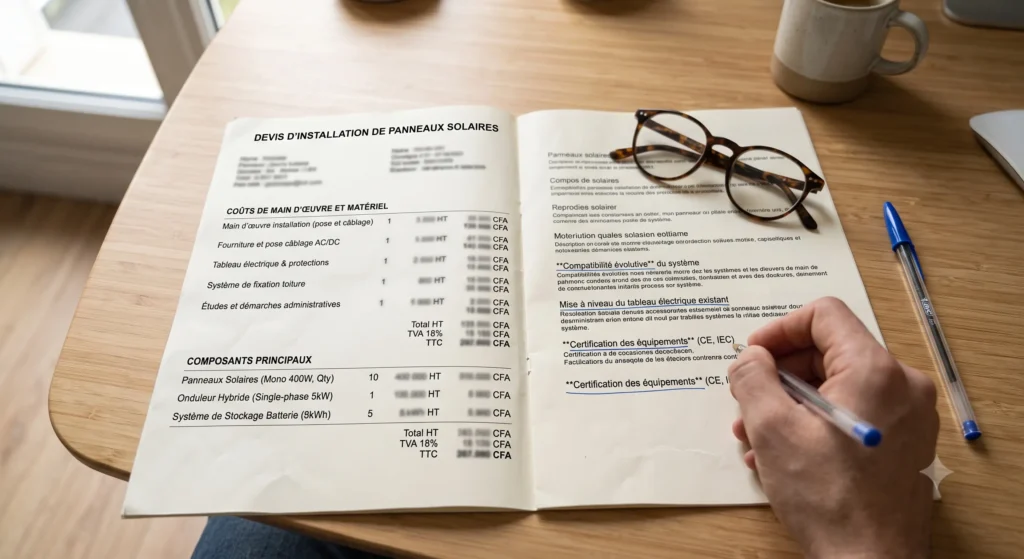
Publisher Disclosure: This article is published by WOW2000 for general informational purposes. No fixed price can be guaranteed without a prior analysis of each household’s specific needs and an on-site technical inspection. Actual costs depend on the chosen configuration, the selected equipment, and the specific constraints of each installation.
Frequently Asked Questions — Cost of a Residential Solar Kit with Backup Power
What is the first question you should ask yourself before calculating the cost of a cut-resistant kit?
The first question is: What do I really want to keep running during a power outage? This list of key loads—with or without air conditioning—is the factor that has the greatest impact on cost. Before requesting a quote, this list must be precise and include the rated power in watts for each device.
Does doubling the battery life double the cost of the kit?
Doubling the runtime roughly doubles the required battery capacity—one of the largest budget items. The total cost of the kit isn’t exactly doubled because the inverter and panels remain the same, but the increase is significant. This calculation should be based on actual power outage data for your neighborhood.
Can we start at the basic level and work our way up to the independent level?
Yes, under certain conditions. For this expansion to be possible without replacing the inverter, it must be selected from the outset with sufficient capacity for the target higher level. This point should be discussed with the installer before finalizing the initial configuration.
Why is WOW2000 able to offer competitive prices on certified equipment?
WOW2000 operates its own manufacturing plant in China—which allows it to source equipment without going through intermediaries. This vertical integration reduces procurement costs without compromising the quality of the equipment or its certifications.
Is the cost of a power-outage kit recoupable over time?
Yes. Savings on the SEEG bill, reduced food waste due to power outages, and eliminated fuel costs for the generator all represent real financial gains that accumulate month after month. The payback period depends on the cost of the kit, the monthly savings generated, and the system’s lifespan.