wow2000.com


What is the budget for residential solar power in Gabon?
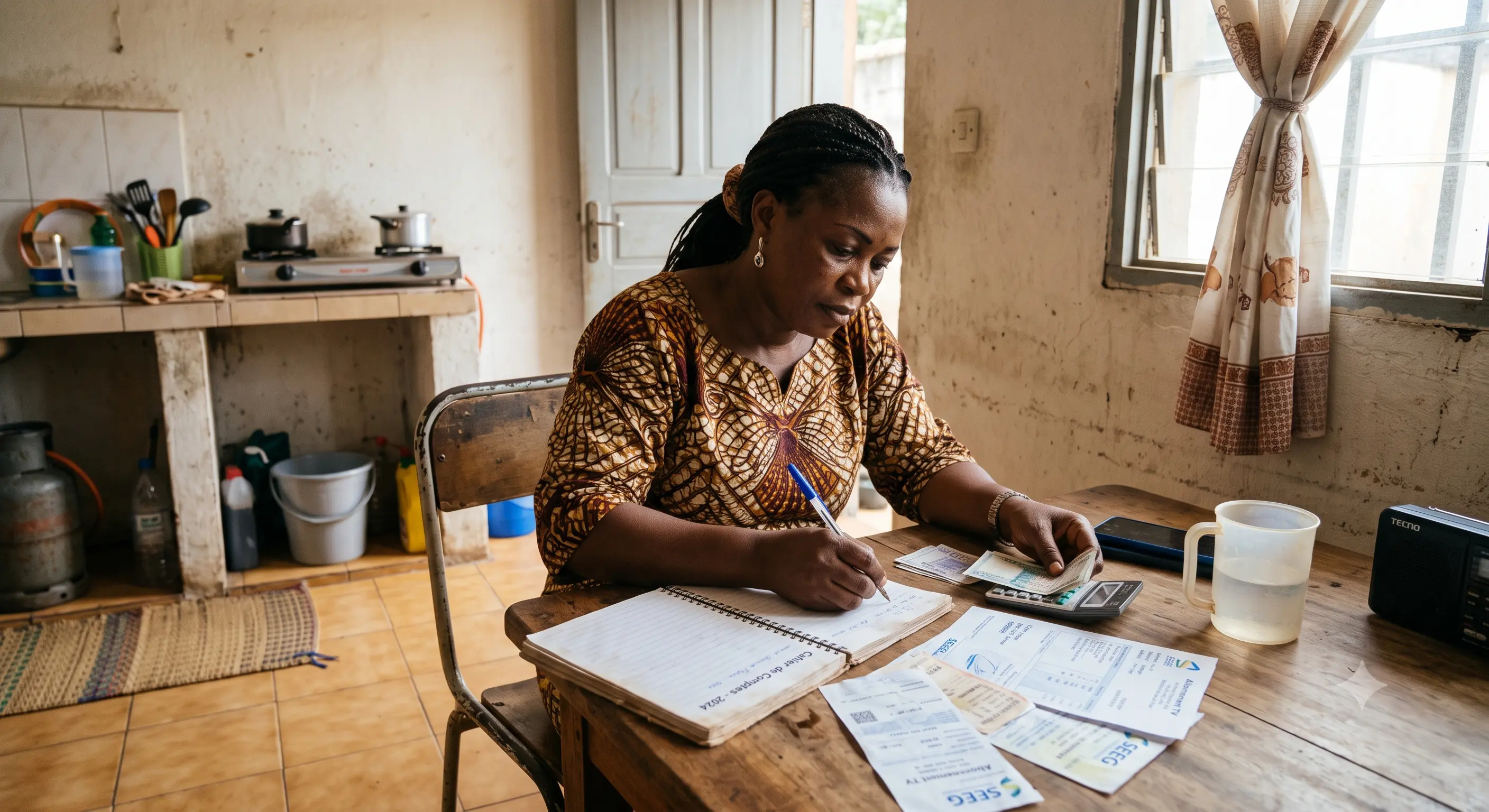
Planning a residential solar budget in Gabon is not the same as answering the question, «How much does it cost?» Budget planning involves deciding the order of investments, how to allocate the budget among the various categories, and how to avoid mistakes that cost more to correct than to anticipate. This article offers a planning framework—not a price list.
To learn more about the categories of solutions offered by WOW2000, visit Our Solutions.
What Planning a Solar Budget Really Means
The first mistake most homeowners make is to start by asking for a price—before they even know what they want. A well-planned residential solar budget starts with decisions, not numbers.
The Difference Between a Price Budget and a Planning Budget
A cost estimate answers the question, «How much does a solar system cost?»—a question no one can answer without knowing your specific needs. For details on the cost components and the factors that influence them, see our article on The cost of a residential solar kit that prevents power outages in Gabon.
A planning budget addresses different and more useful questions. What problem do I want to solve first? In what order should I invest? What is more expensive to fix after the fact than to anticipate from the start?
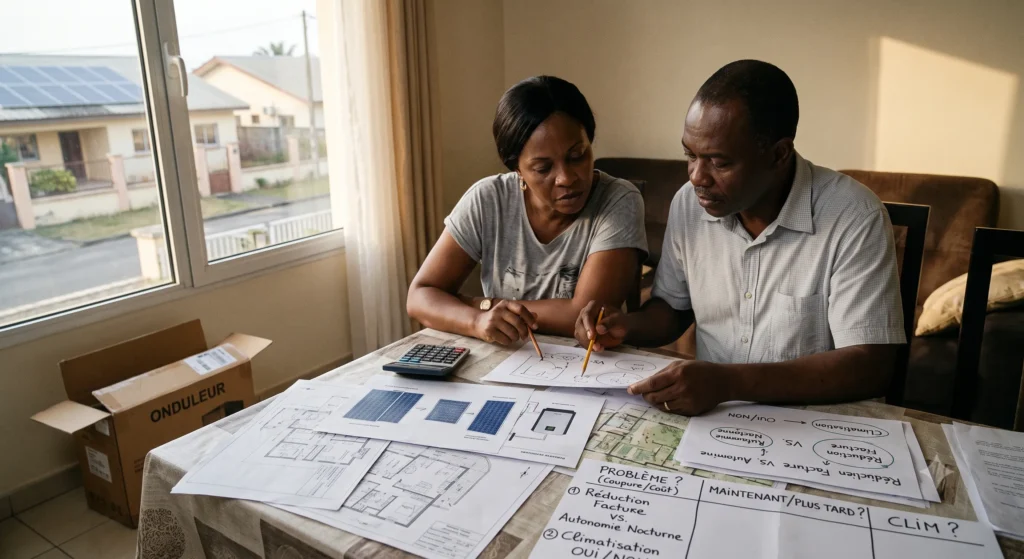
The Three Decisions to Make Before Any Cost Estimation
Before requesting any quotes, three decisions must be clearly made.
Decision 1 — What is my main problem? Reduce my SEEG bill, protect my appliances during nighttime power outages, or achieve complete energy self-sufficiency? These three goals require very different system architectures—and very different budgets. A system designed for daytime self-consumption has a different budget than a system designed to cover nighttime power outages while running the air conditioner.
Decision 2 — Should I invest all at once or gradually? Both approaches are valid—but they don’t cost the same over time. A system designed from the outset to meet all your needs generally costs less over the entire lifespan than a system expanded in several stages—due to additional service costs and the risk of having to replace the inverter if it isn’t sized for the expansion.
Decision 3 — Should I include air conditioning? This is the decision that has the greatest impact on the budget—and it must be made before requesting a quote, not after receiving it. A system with air conditioning and one without are not just two versions of the same quote at different prices—they are two very different designs.
The Order of Investment — What to Fund First
The question of the order of investment is central to the budget planning for a residential solar installation. Not all items are equally urgent or equally costly to postpone.
Why the Inverter Is the Key to Everything Else
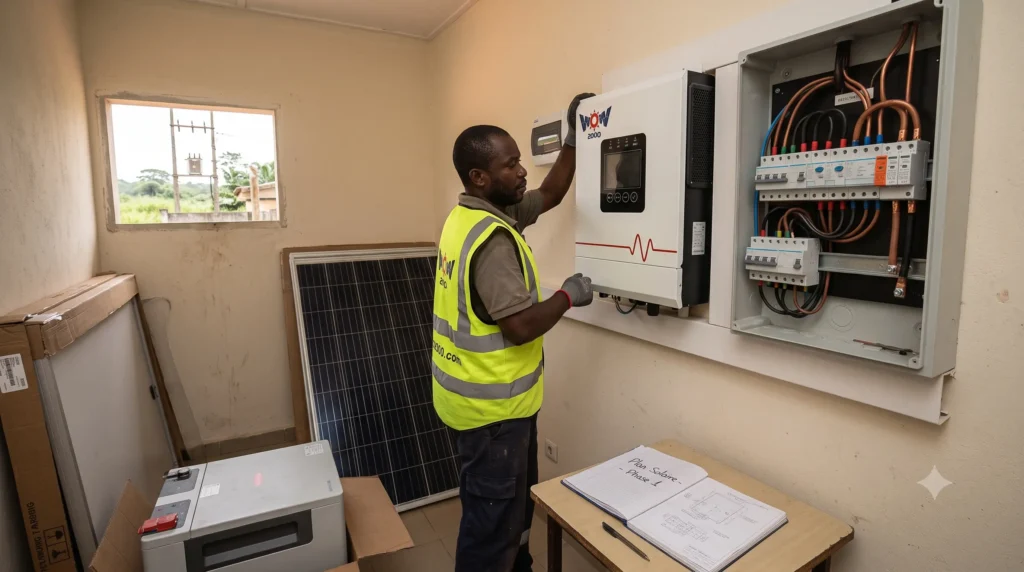
The inverter is the central component that determines the architecture of your entire system. It’s the first investment you need to get right—not necessarily the first one you buy, but the first one you need to size correctly.
Why? Because an undersized inverter that cannot be expanded will force you to replace it entirely if you want to add capacity later on. An inverter that’s properly sized from the start—even if you begin with a small-capacity battery—allows you to expand the system gradually without major additional costs.
The rule is simple: Size the inverter for the final level you're aiming for, even if you're starting at the basic level.
What should be financed first—the battery or the solar panels?
The answer depends on your main goal. If your priority is to protect your devices during nighttime power outages, the battery is the most critical component—it should be sized first. The panels come next to ensure that the battery is recharged during the day.
If your priority is to reduce your SEEG bill during daylight hours, the solar panels should be your first priority—a battery can be added later.
Items That Should Never Be Postponed for Financial Reasons
Certain budget items should never be cut to reduce the initial cost—because they end up costing much more to fix later on.
Electrical Protections — circuit breakers, surge protectors, and cables of the appropriate gauge — are essential components. A lack of protection can damage the inverter or battery during a power surge — a replacement that costs far more than the protection itself.
Upgrading the Electrical Panel — If necessary, this must be done before installation. Making changes to the panel after the system has been installed is more complicated and more expensive.
Equipment Certifications — Failing to verify certifications in order to save money on the initial purchase price is the most costly shortcut in the long run. Non-certified equipment may deteriorate prematurely under Gabonese climatic conditions—and replacing it is always more expensive than purchasing certified equipment from the start.
The Three Investment Options—and How to Choose the Right One
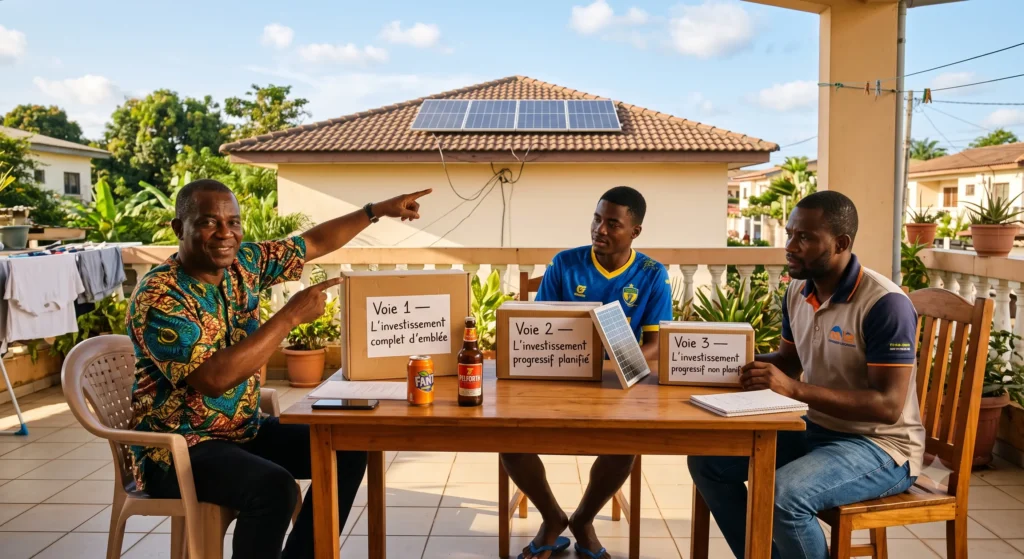
There are three ways to approach investing in a residential solar system in Gabon. Each has its advantages and limitations—depending on your financial situation, your immediate needs, and your long-term goals.
Option 1 — Full Investment from the Start
You make a one-time investment in a system that meets all your long-term needs—whether in terms of package type, battery life, or whether air conditioning is included—right from the start.
The advantage is cost-effective over the long term: a single installation, a single technician visit, a single wiring setup—everything is optimized from the start. The total cost over the system’s lifespan is generally lower than that of a phased approach.
The Limit is immediate budget availability. A comprehensive system tailored to your actual needs requires a higher initial investment than the other two options.
Path 2 — Planned, Gradual Investment
You start with the essentials—refrigerator, lighting, Wi-Fi—and plan the next steps right from the start. The inverter is sized for the final configuration, even if you start with a small-capacity battery.
The advantage is spreading the investment out over time. You get immediate protection against power outages—for essential devices—with a lower initial investment.
The Limit is the cost of additional work required during system expansions—technician travel, additional cabling, and configuration updates. These costs add up and can reduce the savings achieved compared to making a full investment from the outset.
Path 3 — Unplanned, Gradual Investment
You buy a basic system without thinking about future expansion. When you want to expand the system, you discover that the inverter doesn't support expansion—and you have to replace it entirely.
That's the path to avoid. It may seem cost-effective in the short term, but it’s the most expensive option in the long run. The discussion about scalability must take place with the installer before any contract is signed—not after.
What Actually Causes You to Spend More Than Expected
Most budget overruns for residential solar installations in Gabon stem from the same cause—incomplete information at the time the quote is requested. Here are the items that most often catch homeowners by surprise.
Air conditioning—a decision that changes everything
Including a single air conditioner in the scope of the installation after receiving a quote that didn’t include air conditioning can double or triple the budget. This isn’t because air conditioning is excessively expensive—it’s because the original inverter wasn’t rated to handle the startup surge of an air conditioner. Replacing the inverter is then necessary.
The decision to include or exclude air conditioning must be made before requesting a quote—not after. To understand the specific impact of air conditioning on system sizing, see our article on The Best Emergency Solar System for a Home in Libreville.
The outdated electrical panel—a common unexpected expense
An outdated or poorly organized electrical panel requires an upgrade before installation—a cost that is not always included in the initial quote. This cost must be identified during the preliminary technical inspection and included in the total budget from the outset.
The rainy season—an underestimated design parameter
In Gabon, the rainy season reduces solar irradiance for several weeks. A system sized without taking this factor into account may prove insufficient during prolonged cloudy periods—and require the addition of extra battery capacity. An installer familiar with the Gabonese context incorporates this factor into the initial sizing process.
According to the’IRENA, systems that are properly sized to account for local climatic conditions perform significantly better than those calculated using generic data.
Creating Your Budget Planning Spreadsheet
Here is the planning chart that summarizes the decisions to be made and the information to be gathered before requesting a quote.
Decisions and Data to Be Collected
Each line represents a decision or piece of data that directly affects your budget—and without which any estimate would be approximate.
| Decision or data | Its Impact on Budget Planning |
|---|---|
| Main Objective — lower bills, protection against service disconnection, complete independence | Determines the system architecture—three objectives = three different configurations. |
| Air conditioning included or not | A binary decision to be made before the quote — radically changes the inverter's power rating. |
| Investment Strategy — complete or gradual | It affects the choice of inverter starting at the first level. |
| Desired battery life | This affects battery capacity—and its cost. |
| Key loads with power (W) | Used to calculate the minimum power rating of the inverter. |
| Frequency and Duration of Outages | Affects battery sizing and wear. |
| Roof Area and Orientation | Determines the maximum number of panels that can be installed. |
| Status of the Electrical Panel | Allows you to plan for potential upgrade costs. |
What This Planning Helps Prevent
A homeowner who brings this completed form to an installer will receive an accurate and comprehensive quote—not a rough estimate. This helps avoid budget surprises during installation, cost overruns due to unforeseen technical issues, and expansion costs associated with an initial system that isn’t scalable.
Why «the cheapest» Is Rarely the Most Cost-Effective
The distinction between the lowest price and the lowest cost over time is central to budget planning. Cheaper, uncertified equipment that needs to be replaced in two years costs more than certified equipment that lasts ten years. A non-expandable UPS that must be replaced during an expansion costs more than a UPS that is properly sized from the start.
WOW2000 has its own manufacturing plant in China—which allows it to offer certified equipment at competitive prices without going through intermediaries. To prepare your quote request, check out our article on How to Get a Free Quote for Solar Power for Your Home in Gabon.
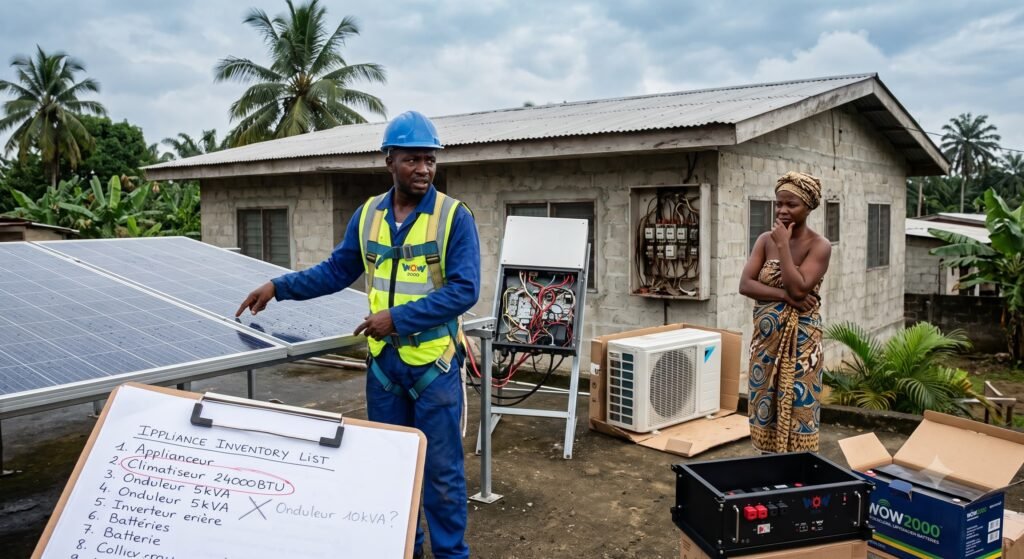
Next step: Turn your plan into a concrete request
Once you've made these decisions and gathered this information, you'll be in a position to request a quote that truly reflects what you want—not a generic quote that you'll have to revise several times before arriving at a suitable proposal.
You can contact the team via WhatsApp or via the page Contact Us.
Publisher Disclosure: This article is published by WOW2000 for general informational purposes only. No standard budget can be provided without a prior analysis of each household’s specific needs. Actual costs depend on the chosen configuration, the selected equipment, and the specific constraints of each site.
Frequently Asked Questions — Residential Solar Budget Planning
What is the first decision you need to make before planning your solar budget?
The first decision is to define your primary goal—reducing your SEEG bill, protecting your devices during power outages, or achieving complete self-sufficiency. These three goals require different system architectures and involve very different budgets. This decision must be made before requesting any quotes.
Why does the inverter need to be sized for the target final level at the time of the initial purchase?
Because a non-expandable inverter will have to be replaced entirely if you want to expand the system. This replacement costs more than the price difference between a small inverter and one that is properly sized from the start. This decision should be discussed with the installer before signing any contract.
Is it always more cost-effective to invest all at once rather than gradually?
Over the long term, yes—generally speaking. A single installation, a single technician visit, and a single optimized wiring setup. But if immediate budget constraints don’t allow for it, a planned, phased approach—with a properly sized inverter from the start—remains a viable option that keeps total costs under control.
Which budget items cannot be deferred without risk?
Electrical protection devices—circuit breakers, surge arresters—and equipment certifications should never be sacrificed to reduce the initial cost. These items are much less expensive to include from the start than to correct after a failure or premature replacement.
How can I tell if my electrical panel needs to be upgraded before installation?
This inspection is conducted during the preliminary technical inspection. It cannot be assessed remotely. An outdated or poorly organized electrical panel may require an upgrade—a cost that must be included in the total budget as early as the planning phase.