wow2000.com


What is the best monocrystalline solar panel in Libreville?
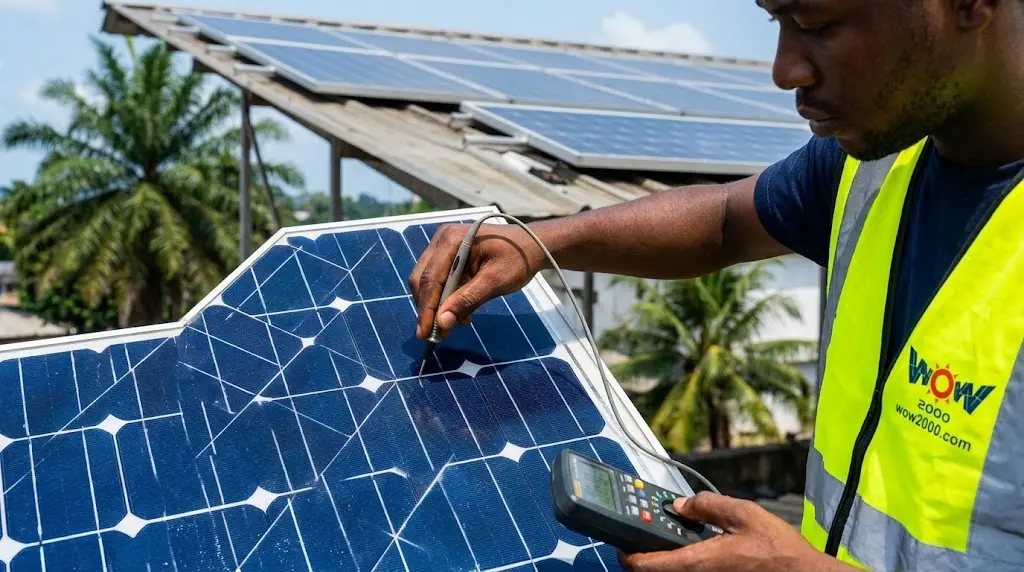
To the untrained eye, a monocrystalline solar panel and a polycrystalline solar panel look the same. However, under Libreville’s climate conditions—intense tropical heat and diffuse solar radiation during the rainy season—these two technologies do not produce the same results. Understanding the technical differences between them allows you to ask an installer the right questions and evaluate quotes on an objective basis.
To learn more about the categories of solutions offered by WOW2000, visit Our Solutions.
The Technical Difference Between Monocrystalline and Polycrystalline
How Crystal Structure Affects Energy Production
The fundamental difference between a monocrystalline panel and a polycrystalline panel lies in the structure of the silicon used to manufacture the cells.
A sign single-crystal is made from silicon ingots derived from a single crystal—produced using the Czochralski process. This uniform structure allows electrons to move with less resistance, resulting in a higher conversion efficiency. Modern monocrystalline panels achieve efficiencies of 20 to 23% under standardized testing conditions.
A sign polycrystalline is made from silicon that has been cooled as a single block—which forms several contiguous crystals. The grain boundaries between these crystals create additional resistance to the movement of electrons. The typical efficiency of polycrystalline panels ranges from 15 to 18% under the same measurement conditions.
For a roof area of the same size in Libreville, a monocrystalline panel of the same dimensions therefore produces between 15 and 30% more energy than its polycrystalline counterpart.
What the Temperature Coefficient Means for Libreville's Climate
The temperature coefficient is the most important parameter to check in the technical specifications of a photovoltaic panel intended for use in Libreville. It indicates the panel’s power loss for each degree Celsius above 25°C—the reference temperature for standardized measurement conditions.
A typical panel has a temperature coefficient ranging from -0.3% to -0.45% per degree Celsius. In practice, a panel exposed to the sun in Libreville can reach a surface temperature of 60 to 70°C on sunny days. For a panel with a coefficient of -0.4%/°C and a surface temperature of 65°C—that is, 40°C above reference conditions—the actual power loss is 40 × 0.4% = 16%.
A panel rated at 400 watts therefore produces only 336 watts under actual conditions during the hottest hours in Libreville. This loss is unavoidable—it must be factored into the system design. A lower temperature coefficient—in absolute terms—means less power loss at high temperatures. This parameter should be compared across multiple product specifications before making a purchase.
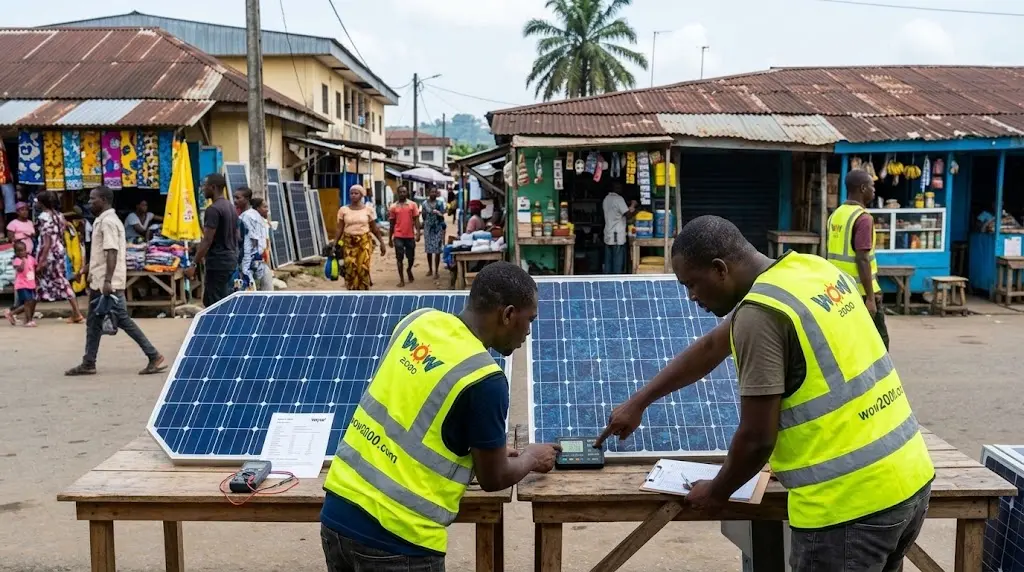
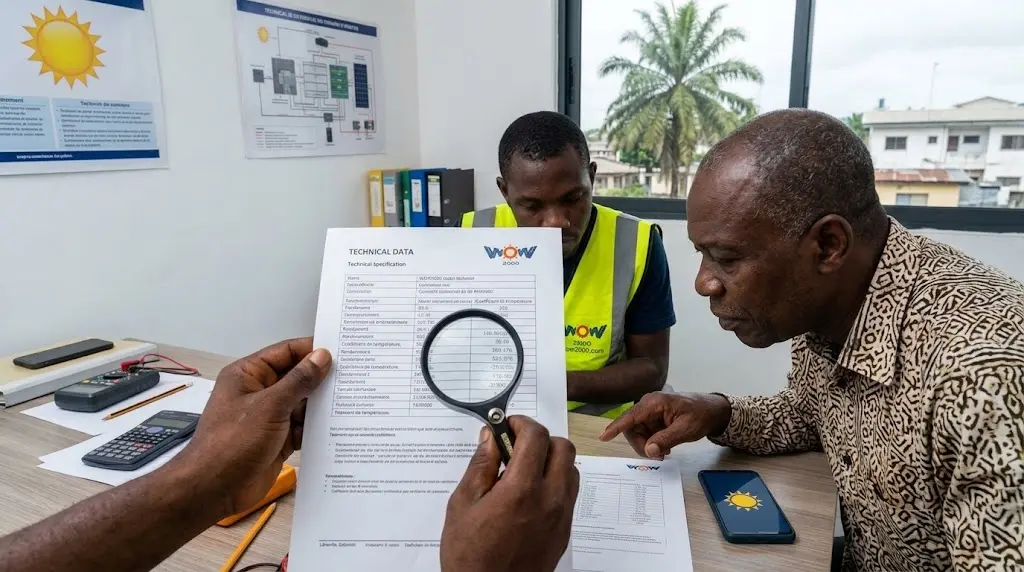
Technical specifications to check in a technical data sheet in Libreville
Mandatory certifications — proof that a panel has been tested
Two international certifications are required for a panel designed for the climatic conditions in Libreville.
IEC 61215 Certification certifies that the panel has passed mechanical and climatic durability tests—resistance to snow and wind loads, resistance to thermal cycling, resistance to humidity and damp heat, and resistance to hail. An IEC 61215-certified panel has demonstrated its ability to maintain its performance under harsh climatic conditions.
IEC 61730 Certification certifies that the panel meets electrical safety requirements—insulation, short-circuit resistance, and fire safety. It is essential for any panel intended for residential or commercial installation.
These certifications must be verifiable in the manufacturer's original documentation—not merely mentioned in a sales brochure.
The specifications to compare
| Parameter | What It Means for Libreville | How to Read It |
|---|---|---|
| Yield (%) | The higher it is, the less roof area is needed to produce the same amount of energy. | Look for a value of % — 20% or higher for high-quality monocrystalline silicon. |
| Rated power (Wp) | The power measured under standardized conditions—not the actual power in Libreville. | Peak power in watts (Wp) at 25°C and 1,000 W/m². |
| Temperature coefficient (%/°C) | Power loss for each degree above 25°C. | Look for the value closest to 0—for example, -0.30%/°C is better than -0.45%/°C. |
| NOCT (°C) | Nominal operating temperature — provides a more accurate representation of actual conditions than a measurement taken at 25°C. | A NOCT of 42°C is better than a NOCT of 48°C in terms of actual yield. |
| Power Tolerance (%) | The possible difference between the rated power and the actual power. | Opt for a positive tolerance—for example, +3%/-0% means that the panel produces at least the rated power. |
| Performance Warranty (years) | The period during which the manufacturer guarantees a minimum power level. | Check the bearing—for example, 90% at 10 years and 80% at 25 years. |
What the weather pattern on cloudy days means for Libreville
Diffuse production—an often-overlooked factor
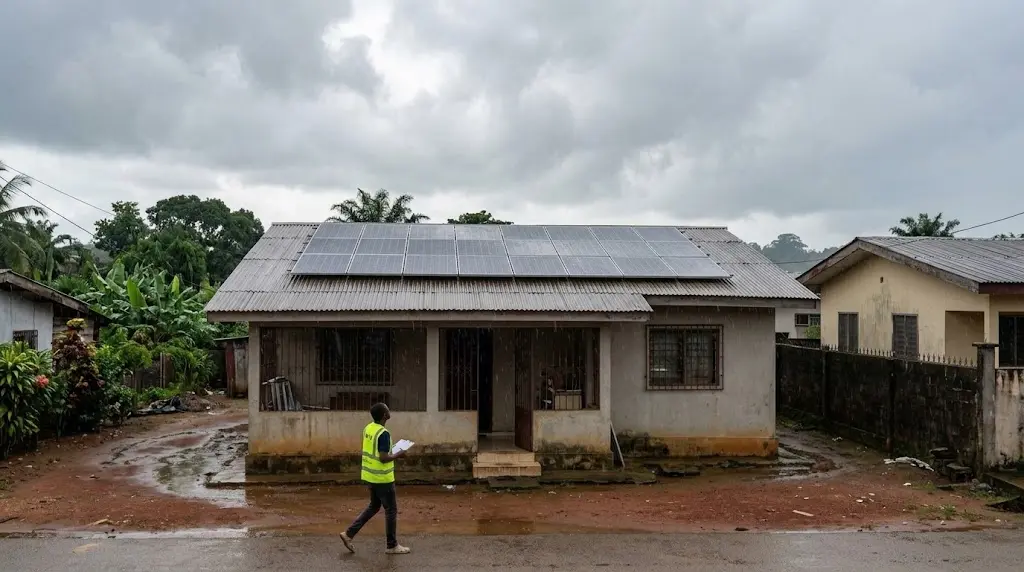
Libreville has two rainy seasons each year—a long one and a short one—during which cloud cover is common. During these periods, the panels no longer receive direct sunlight but rather diffuse radiation—light that passes through the clouds.
A monocrystalline panel typically produces between 10 and 25% of its rated power under heavily cloudy conditions. A polycrystalline panel produces between 8 and 20% under the same conditions. The difference may seem small in percentage terms—but when accumulated over several weeks of the rainy season in Libreville, it represents a significant difference in the amount of energy stored by the battery.
The Angle of Incidence and Its Impact on Diffuse Production
Power output under diffuse sunlight also depends on the cell technology. Modern monocrystalline cells—particularly PERC (Passivated Emitter and Rear Cell) technologies—have a better spectral response to the wavelengths that dominate under overcast skies. Specifically, a monocrystalline PERC panel produces more power under cloudy skies than a standard monocrystalline panel with the same rated power.
This factor—which is often overlooked in sales pitches in Libreville—is particularly relevant for a system that needs to keep a battery charged during the rainy season. To understand how this distributed generation fits into the overall system design, see our article on How to Choose an Off-Grid Residential Solar Kit in Gabon.
Questions to Ask Before Buying a Monocrystalline Solar Panel in Libreville
How to Verify That a Panel Is Genuinely Certified
The Libreville market offers a wide range of prices for panels marketed as «monocrystalline.» Not all of them are actually certified products. Here are the essential checks to make before making a purchase.
- Is the IEC 61215 certification listed on the technical data sheet along with the certificate number? A reputable seller can provide this number—which can be verified in the databases of certification organizations.
- Is the power tolerance positive or symmetrical? A tolerance of ±3% means that the panel can produce up to 3% less than the rated power. A tolerance of +3%/-0% guarantees that the actual power is at least equal to the rated power.
- Is the NOCT listed in the technical data sheet? Its absence indicates that the record is incomplete or has been reconstructed.
- Is the performance guarantee in writing, and not just verbal? A reputable manufacturer provides a separate warranty document specifying the guaranteed performance levels over 10 and 25 years.
How many solar panels are needed to meet the energy needs of a household in Libreville?
The number of panels needed depends on the household's daily energy consumption, the power output per panel, and the amount of sunlight available in Libreville.
For a household with a daily energy consumption of 3,000 Wh—refrigerator, lighting, fans, chargers—and 400 Wp solar panels, the basic calculation is as follows: 3,000 Wh ÷ 4.5 hours of usable sunlight in Libreville ÷ 0.75 (system efficiency) = 889 Wp of required power. That is approximately 3 panels of 400 Wp each.
If air conditioning is included in the scope—with additional consumption of 1,500 to 2,000 Wh per night—the total requirement rises to 4,500 to 5,000 Wh, or 5 to 6 400 Wp panels. These calculations are initial estimates—precise sizing takes into account the actual hourly consumption profile, potential shading, and the desired safety margin.
According to the’IRENA, residential photovoltaic systems that are properly sized based on local sunlight conditions perform significantly better than those calculated using generic data.
Warning Signs in the Libreville Real Estate Market
An unusually low price for high power
A 400 Wp panel sold at a price significantly below international market benchmarks warrants a thorough investigation. The manufacturing of certified-quality monocrystalline cells has a minimum cost below which IEC certification cannot be obtained. A very low price may indicate that the actual power output is lower than the stated rated power, or that certifications are missing or unverifiable.
A technical data sheet in a foreign language without translations of the key parameters
A technical data sheet available only in Chinese or English, without clearly identifying key parameters—efficiency, temperature coefficient, NOCT, and tolerance—is not useful for comparing quotes. A reputable installer can provide these parameters translated and explained.
A verbal performance guarantee without a written document
A solar panel’s performance warranty is one of the most important aspects of the investment in Libreville. It must be provided in writing by the manufacturer or importer—not just verbally promised by the local seller.
What You Need to Prepare to Get an Accurate Measurement in Libreville
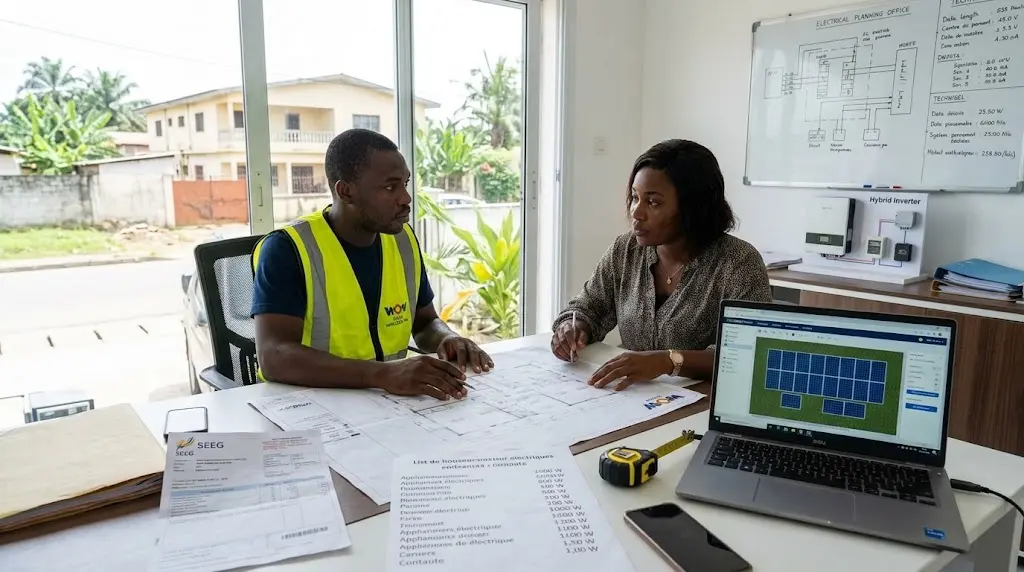
Before contacting an installer for a project involving monocrystalline panels in Libreville, gathering this information will help ensure an accurate sizing.
- Your most recent SEEG bill along with monthly consumption in kWh.
- A list of your appliances and their rated power — as indicated on the label or in the manual for each device.
- Your Decision on Air Conditioning — whether or not it is included within the system's scope.
- The approximate available area on your roof and its main focus.
- Photos of Your Roof to identify any potential shading.
To prepare your request for a quote, check out our article on How to Get a Free Quote for Solar Power for Your Home in Gabon.
You can contact the team via WhatsApp or via the page Contact Us.
Next step: Get a quote tailored to your roof in Libreville
Choosing a certified monocrystalline panel with a good temperature coefficient is a necessary—but not sufficient—condition for a high-performance installation in Libreville. The precise sizing of the number of panels, their optimal placement on the roof, and their integration with a properly selected inverter and battery determine the system’s actual performance.
To understand how these panels fit into a complete system, see our article on How to Ensure a Reliable Residential Solar System in Gabon.
Publisher Disclosure: This article is published by WOW2000 for general informational purposes. The efficiency, temperature coefficient, and power output values presented are general estimates based on technologies available in 2026. The actual performance of a specific panel in Libreville depends on installation conditions, orientation, shading, and the parameters specified in the manufacturer’s technical data sheet.
Frequently Asked Questions — Best Monocrystalline Solar Panel in Libreville
What is the practical difference between monocrystalline and polycrystalline solar panels for a home in Libreville?
For the same roof area, a monocrystalline panel produces between 15 and 30% more energy than a polycrystalline panel of the same size. In Libreville, this advantage is particularly relevant for roofs with limited space or for households that wish to maximize energy production without increasing the installed area. The typical efficiency is 20 to 23% for monocrystalline panels, compared to 15 to 18% for polycrystalline panels.
What is the temperature coefficient, and why is it important in Libreville?
The temperature coefficient indicates the loss in power output of a panel for every degree Celsius above 25°C. In Libreville, a panel exposed to the sun can reach surface temperatures of 60 to 70°C. For a coefficient of -0.4%/°C and a temperature of 65°C, the actual power loss is 16%. A coefficient of -0.30%/°C reduces this loss to 12% under the same conditions. This parameter should be compared across multiple technical data sheets before making a purchase in Libreville.
Does a monocrystalline panel actually generate power during the rainy season in Libreville?
Yes. A monocrystalline panel typically produces between 10 and 25% of its rated power under heavily cloudy conditions. Modern monocrystalline PERC technologies respond better to the dominant wavelengths under overcast skies—which improves their relative output under diffuse sunlight compared to standard monocrystalline panels.
How can you verify that a panel is genuinely IEC 61215-certified in Libreville?
The IEC 61215 certification must be listed on the manufacturer’s technical data sheet along with the certificate number issued by the certification body. This number can be verified in the databases of accredited organizations. A seller who cannot provide this number or who offers only a sales brochure cannot guarantee the authenticity of the certification.
How many 400 Wp monocrystalline panels are needed for a standard household in Libreville?
For a household with a daily consumption of 3,000 Wh without air conditioning, approximately 3 panels of 400 Wp are needed—based on 4.5 hours of effective sunlight in Libreville and a system efficiency of 75%. If air conditioning is included in the calculation—adding an additional 1,500 to 2,000 Wh of nighttime consumption—the number of panels needed increases to 5 or 6. These estimates must be refined during a study based on your actual consumption.